























AfloatMagazine: The Sailing Legacy of John Breslin Kearney:…
YouTube Vimeo Twitter Facebook

Popular Sailing News

Tuesday, 16 August 2011

Rambler 100 Capsize - 'A Scary Moment We Will Not Forget'

Share to Twitter Share to Facebook Share to Email More...

At midnight, Monday 15 August, Eddie Warden Owen, Chief Executive of the Royal Ocean Racing Club received a call from Mick Harvey, Project Manager of George David's Rambler 100 (USA). Harvey spoke about the harrowing incident when the 100' Maxi Rambler 100 capsized in the Celtic Sea during the Rolex Fastnet Race.
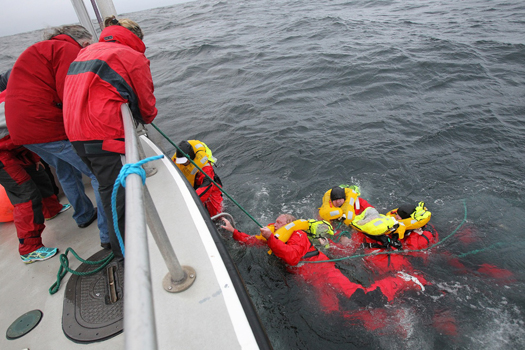
Rambler_rescue_phaedo_4

The incident happened just after Rambler 100 rounded the Fastnet Rock at 17:25 BST. At the time, Rambler 100 were leading the monohull fleet and vying for monohull line honours in the Rolex Fastnet Race which started on Sunday 14th.

Mick Harvey's account of the incident was charged with emotion. The tough Australian, who now lives in Newport, Rhode Island (USA), is a seasoned veteran, but he was understandably shaken by the incident:

"Soon after rounding the Fastnet Rock, the wind went southwest, right on the nose. We were beating into big seas, launching Rambler off the top of full size waves. I was down below with navigator, Peter Isler when we heard the sickening sound of the  keel breaking off. It was instantaneous; there was no time to react. The boat turned turtle, just like a dinghy capsizing. Peter Isler issued a Mayday and we got out of there as quickly as we could."

The EPIRB had been activated and a number of crew climbed over the guardrails and onto the hull as the boat capsized and helped those swimming to safety. The Atlantic swell made it difficult for the crew to get out of the water however, working together, 16 of the crew managed to scale the upturned hull.

Five of the crew were swept away by the waves out of reach of the stricken Maxi and these included Skipper, George David and partner Wendy Touton who were in the water for two and a half hours. This group linked arms, forming a circle. Valencia Coastguard diverted a local fishing boat, Wave Chieftain to assist, which winched the crew on board. Earlier a helicopter had been scrambled from Shannon Airport helicopter, Wendy Touton was airlifted for medical attention due to the effects of hypothermia and the four remaining crew were taken to Baltimore Harbour where they were re-united with the 16 crew rescued by the Baltimore Lifeboat.

"It was a scary moment. One that I will never forget," admitted Mick Harvey. "I can't begin to tell you how relieved I am that all of the crew are safe. The town of Baltimore has given us a wonderful welcome. I can not thank our rescuers and the people of this lovely village enough. Wendy is in Kerry Hospital and doing fine, I am just so relieved that everybody is okay."


5 comments

  • Comment Link Adam Wednesday, 17 August 2011 23:25 posted by Adam

    Never saw it on ICAP - that's fog for you..
    p.s. is that Mike Perrin?

  • Comment Link Stephen Santoro Wednesday, 17 August 2011 03:12 posted by Stephen Santoro

    I saw Rambler start the trans atlantic race a few weeks ago. Glad to hear all are ok and safe. Sephen from newport/ jamestown, RI

  • Comment Link William Hofmeister Tuesday, 16 August 2011 23:20 posted by William Hofmeister

    George, Pedro, glad you are safe! ANd I wanted to ride on that beast!

  • Comment Link James Kemp Tuesday, 16 August 2011 21:20 posted by James Kemp

    It’s unfortunate – but this sort of incident is not uncommon. It is just the latest in a string of incidents caused by the fragile canting keel design. So many yachtsmen continue to believe it is the only way to increase speeds and efficiency through the water – will it take a high-profile fatality for them to accept that there is a superior alternative?

    I truly believe that DSS is the future of performance yachting - it's more economical and resilient, yet provides higher speeds, better stability and simplified operation. Surely, it's a no brainer? DSS is already being built in to yachts of up to 50-foot in length and eliminates entirely the risks associated with canting keel mechanisms.

    The Rambler 100 crew was lucky – it was daylight, they were close to land, and they were taking part in a high-profile event monitored by numerous expert rescue crews – but I desperately hope that the yachting world will now accept that the canting keel concept is fundamentally flawed. Such disasters cannot continue to happen. Especially when proven alternatives are so readily available.

  • Comment Link M S Perrin Tuesday, 16 August 2011 12:40 posted by M S Perrin

    ICAP Leopard was apparently following not far behind Rambler. Why did they not help?
    M S Perrin


newsletter graphic

If you'd like more news, views and stories about Ireland's sailing, boating and maritime scene please sign up to our enews letter, follow us on facebook and twitter


Fastnet Yacht Race

The biennial Rolex Fastnet Race is open to both monohull and multihull sailing yachts. It has been an established fixture on the ocean racing circuit since 1925. The 608-nautical mile race is a test of strategy and skill with crews encountering challenging tidal currents and changeable weather. The fleet starts from the renowned Royal Yacht Squadron off Cowes in the United Kingdom, races out of The Solent and westward down the English Channel before crossing the often tempestuous Celtic Sea to the Fastnet Rock, and then returning on a reciprocal course to the finish off Plymouth.