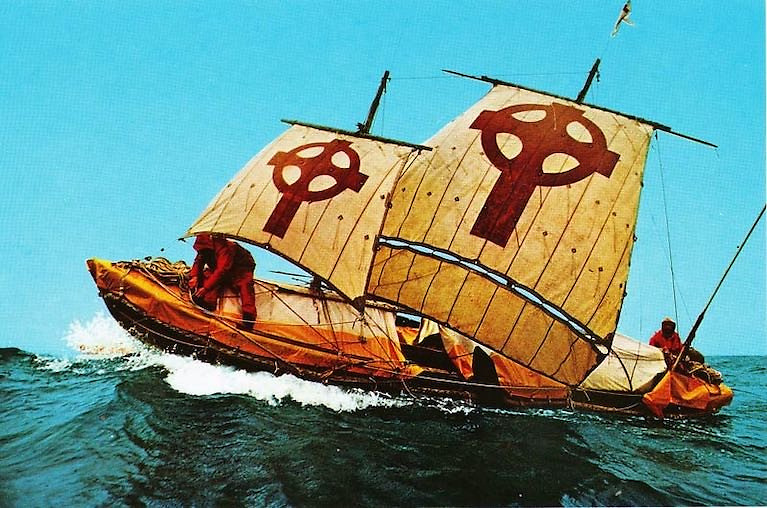
When the Vikings began to settle Iceland around 870 AD, they found they weren’t the first exploring voyagers there from Europe. There were small Irish religious settlements already established, as had earlier been found to be the case close to the south, in the Faroes. And in 1976-77, explorer Tim Severin was to demonstrate with the Brendan Voyage that the possibility that St Brendan the Navigator (484-577) had discovered America from Ireland via the northlands was certainly valid, however much modern scholars may argue about it.
There’s a certain Eurocentric arrogance about all this, as the high latitude lands around the far northwest Atlantic were already inhabited - albeit sparsely – by “First Peoples” who had adapted to the extremes of their environment. They could so successfully spend long days at sea in Arctic conditions on their kayaks that when storms had blown them far offshore, their occasional arrival – admittedly often barely alive – on the remote west coasts and islands of Scotland were faithfully recorded by the local 17th Century Presbyterian ministers.
 Small boat, big ocean. The St Brendan takes her departure from the Dingle Peninsula in 1976.
EUROPE’S POLAR VOYAGING PIONEERS
Thus the Irish monks were no more and no less than Europe’s polar voyaging pioneers. But the religious mysticism that motivated their voyaging meant they weren’t empire builders. And nor were the Atlantic-crossing Basque fisherman, who kept their knowledge of the fish-rich coast of North America as a trade secret. So by the time rapidly-expanding European nation states in more modern times were sending record-keeping land-claiming expeditions with commercial ambitions towards the North and South Poles, the Irish may have been playing key individual roles, but they were now in a subsidiary position, and any success achieved accrued to the sponsoring nation, usually Britain.
 The Ice Man – Tom Crean of Annascaul had unrivalled experience of the Antarctic.
It’s a situation which has been highlighted by the increasing recognition – both at home and abroad - of the great Tom Crean (1877–1938) of Annascaul on the Dingle Peninsula, who played central roles in the polar expeditions of Robert Falcon Scott and Ernest Shackleton in the early 20th Century. Tom Crean and his achievements had been absorbed into the British imperial narrative, but his extreme experiences and heroic performance in ultra-high latitudes had been so remarkable that he has provided an ideal figurehead for the development of the Irish polar awareness movement.
IRISH POLAR INSTITUTE FOUNDED
This sense of Irish involvement has been further broadened in the last hundred and more years, as Irish amateur sailors have made cruises which were in effect expeditions into the high ice, strengthening an interest in finding out more about other Irish who had been there before. It was only a matter of time before some structure was put on this interest, and in the summer of 2025 the Irish Polar Institute finally came into being, spearheaded by Paddy Barry of Connemara and Dun Laoghaire, Ireland’s definitive high latitude voyager and mountaineer, and fellow-voyager Jarlath Cunnane of Mayo.
 A man of the icy mountains and frozen sea – Paddy Barry has played a central role in the creation of the Irish Polar Institute
The IPI has been launched with generosity of spirit, as a central purpose is the awarding of an annual medal whose aim is to honour the memory – often forgotten – of individuals of all nations whose achievements in high latitudes do not at present receive the recognition they deserve.
 Arctic regulars and IPI founders Jarlath Cunnane and Mick Brogan with the Mayo-built expedition yacht Northabout
With a voyager – both global and high latitude - of the status of Maire Breathnach of Dungarvan stepping up to the plate to take on the IPI chairing role, we begin to get an idea of the calibre, experience and achievement of the new Institute’s membership. And it will all become more tangible on Friday, January 30th 2026 when the inaugural Irish Polar Dinner will be hosted by the new Institute at the National Yacht Club in Dun Laoghaire.
 IPI founding chair Maire Breathnach at Cape Horn. Her remarable voyaging record began by becoming the first woman to sail round Ireland single-handed. Photo: Andrew Wilkes
OPEN TO ALL
Membership of the IPI is open to all, it’s a very reasonable €20 per annum, and at this stage of development the best contact point is Paddy Barry himself, email is [email protected], phone 087 928 2393.
Meanwhile, the founding committee has been busy in setting up a Newsletter (the first is due out in two weeks’ time) and whittling down the list of potential first recipients of the IPI Medal. The breadth of vision shown in the nominations speaking volumes both for the spirit of the Institute, and the significant numbers and extraordinary variety of people – sometimes virtually unknown - who have done great things in icy places.
VARIETY OF THE “UNKNOWNS”
A classic case in point is Ada Blackjack (1898-1983). She was an Inuit woman in Alaska who was retained by Vilhjalmur Steffanson to provide support for the four man expedition he was sending to over-winter on Wrangel Island in the high Arctic. She was nominated by Paddy Barry himself, as he was very impressed by her survival skills, not all of which she could get accepted by the four white males who saw themselves as her bosses. Consequently they all perished whereas she survived, but was subsequently badly treated by Steffanson.
Then there’s Valerian Albanov (1881-1919) who navigated the ship Santa Anna that was frozen in for a year and a half in the Kara Sea. Eventually, it was he who led the crew to safety southwards across 235 miles of treacherously frozen sea.
 The Bransfield Monument was erected in Ballinacurra in 2020, the Bicentenary of Edward Bransfield’s first sighting of the Antarctic landmass.
As the IPI builds up its data base, the Irish involvement became more clearcut. For instance, there are five noted sailors from County Cork who would be eligible for the IPI Medal. Significant among them is Edward Bransfield (1785-1852) from Ballincurra on Cork Harbour, who – near his home as a boy - was press-ganged aboard a ship of the Royal Navy in the Nelson era. Somehow he survived the harsh youthful experience, and had his best revenge by living long and well, rising through the ranks until, as a Ship’s Master and Expedition Leader in 1820, he succeeded in achieving the first properly recorded sighting of the Antarctic land-mass.
INEVITABE FOCUS ON SHACKLETON
Inevitably, much of the focus of our attention tends to be on the expeditions of Ernest Shackleton (1874-1922). He was born in Count Kildare, but public schooling in England at Dulwich College (other noted alumni include P G Wodehouse, Raymond Chandler and the unfairly over-looked C S Forrester) made Shackleton seem very English to the Irish, but somehow more Irish than ever to the English as he promoted his various Antarctic expeditions and the ferocious fund-raising tours they involved.
 Ernest Shackleton – he was seen as Irish in England, and English in Ireland.
He’d go anywhere in hope of finding additional generous patrons, and ended up in Imperial India refusing to take “No” for an answer to such an extent that a senior Civil Servant described him as “a feckless Irishman”, which is pretty final. Yet it was in supposedly canny Scotland that he found one of his best supporters in the Dundee jute baron, mathematician and public benefactor Sir James Caird.
CAIRD’S SUPPORT FROM DUNDEE WEALTH
Caird’s support was to be commemorated in naming the main ship’s boat on Shackleton’s ship the Endurance in his honour. Yet despite this initial and vital Scottish support, and the Scottish skill of ship’s carpenter Harry McNish in converting the James Caird into a seagoing proposition to voyage towards South Georgia in a successful search for help for the rescue of the main expedition, when it came to King George V distributing the Polar Medals to Shackleton’s crew, their commander Ernest Shackleton deliberately left the often obtuse McNish out in the cold.
 The Original – the expedition-saving James Caird as modified by Harry McNish on display in Dulwich School.
As the deserved adulation for the be-medalled Tom Crean has increased over the years, so too there has been an increasing groundswell in support of honouring the memory of the irascible Glaswegian Harry McNish. He died destitute in New Zealand in 1930, but is now well commemorated with a distinctive grave in Karori Cemetery in Wellington featuring his much-loved ship’s cat Mrs Chippy, shot dead by Shackleton as he (Mrs Chippy was a tomcat) was seen by The Boss as a burden when the Endeavour was abandoned in the ice of the Weddell Sea.
 Remembered at last. The grave of Harry McNish in New Zealand, including the much-lamented Mrs Chippy, who was actually a tomcat.
REPLICAS OF LIFEBOAT JAMES CAIRD
For cat lovers everywhere, this is all a bit much, so a consolation of sorts has been building replicas of the James Caird as successfully modified by Harry McNish. People even argue as to the exact dimensions, which is a bit odd as the original survived in the tiny gap in the cliffs of the south coast of South Georgia until, in 1919, she was brought back to England by the whaler Woodville, and is now on display in Dulwich College.
 Jarlath Cunnane putting the planks in place on his replica of the James Caird at his workshop on the shores of Clew Bay. The boat is now on display at Tom Crean’s South Pole Inn at Annascaul on the Dingle Peninsula
Be that as it may, there’s a replica built by Jarlath Cunnane at Tom Crean’s South Pole Inn at Annascaul, and there’s another in the recently-opened Shackleton Museum in Athy. So now with the James Caird well commemorated, it is more than timely to honour the man whose skills made her historic voyage possible, and at the Irish Polar Institute inaugural dinner on January 30th, the first IPI Medal will be presented to a relative from Glasgow of Harry McNish, his nomination having been made by Andrew Wilkes (aka Mr Maire Breathnach) whose voyaging – including transits of the great Arctic passages with the steel-built gaff yawl Young Larry – are deservedly legendary in themselves.
 The steel gaff yawl Young Larry in which Andrew Wilkes and Maire Breathnach of Dungarvan made very extensive High Latitude voyages
THE FAMOUS FOAM
It’s an imaginative, wide-ranging move that opens all sorts of possibilities. For instance, who would receive the medal for Lord Dufferin, founding Commodore of the Royal Ulster YC? His 1856 voyage to high latitudes with the schooner Foam continues to be inspirational, as does the Foam herself.
She was to serve as the Falkland Islands Government mail schooner from 1864 to 1872, which gives us links to circumnavigator Conor O’Brien, as his creation, the 56ft Ilen now restored and sailing in Ireland, served as one of Foam’s successors from 1926 until 1990.
 The schooner Foam. Her voyage to the High Arctic in 1856 continues to be inspirational. Subsequently she was the Government Mail Vessel in the Falkland Islands from 1864-1872.
 The restored Ilen in west Greenland waters in 2019 under the command of Gary Mac Mahon of Limerick. She had served as the Mail Vessel in the Falklands from 1926 to 1990. Photo: Gary Mac Mahon
“ALARMING SUDDENNESS’
Yet with alarming suddenness, the main Dufferin line became extinct, and people who are into this kind of thing tell us that the most likely recipient of an IPI Medal in honour of Lord Dufferin would be a connection of Sheridan Lowell (1971-2011), Irish-born son of a marriage between Caroline Blackwood, grand-daughter of the ice-exploring Marquess of Dufferin. She was the wife of artist Lucien Freud before marrying the twice-married American poet Robert Lowell of the distinguished family in Boston, home of the bean and the cod, where the Lowells talk to the Cabots, and the Cabots talk only to God.
Another noted Arctic voyager was Henry Gore-Booth (1843-1900) of Lissadell near Sligo. Now best remembered as the father of Constance Markievicz, his first Arctic experience had been in the 1860s with another Irish voyaging explorer, the limbless Arthur Macmorrogh Kavanagh of Borris in County Carlow. Then in the early 1880s - by now an active member of the international Arctic voyaging community - he commissioned the building in Sligo of the special 45-ton ketch Kara for an ultimately successful expedition to Nova Zemlya in search of the missing explorer Leigh Smith.
 Henry Gore-Booth’s Sligo-built 45ft ketch Kara in the ice of Nova Zemlya in 1882
 The model of Kara is now on display in Lissadell House.
AFFINITIES WITH GALWAY HOOKER
At first glance Kara looks to be a fairly typical hefty cruising ketch of the time, but closer inspection reveals her hull to have affinities with the Galway hooker. This is a reminder that of all the boats and ships that feature in this litany of Irish high latitude voyaging, only the Kara of Sligo, Paddy Barry’s hooker St Patrick of Connemara, the ketch Ilen of West Cork, and Jarlath Cunnane’s expedition yacht Northabout of Westport in Mayo have been built in Ireland.
 The Mayo-built Northabout in clear water
 Northabout at work
 A healthy family of Polar bears as seen from Northabout twenty years ago – their survival situation has since deteriorated.
GORE-GRIMES LEADS THE WAY
The more modern wave of high latitude Irish voyaging began in the late 1970s with John Gore-Grimes of Howth with his much-travelled little Nich 31 sloop Shardana, with achievements which were honoured with the Cruising Club of America’s Blue water Medal in 1984. Since then the boundaries have been dramatically pushed, helped to some extent by global warming, and now most Arctic sailors expect to include some sort of research in addition to the usual programme of cruising.
 A very rare sight – bright sunshine on Jan Mayen and Beerenberg as seen from Nick Kats’ ketch Teddy from Clifden
SICKENING STUFF
A classic case in point is Nick Kats of Clifden with his 39ft Danish-built ketch Teddy. An advanced nutritionist, he has used his extensive Arctic voyages - he has even seen sunshine on Beerenberg in Jan Mayen - to research and experience the more extreme diets which high latitude dwellers see as normal, cheerfully and thoughtfully consuming stuff that sickens his shipmates – “even the very thought of it is enough”.
 The ketch Teddy of Clifden in East Greenland.
 “He’ll eat almost anything in the interests of nutritional research”. Nick Kats with a storm-battered Teddy in the Northwest Fjords of Iceland.
ACHIEVEMENT WITH STANDARD BOATS
While many High Latitude sailors expect to have a special boat for their voyages, it’s impressive how many cruising folk with standard production boats - albeit very well-prepared standard boats – have succeeded in significant ventures. A star performer in this category is Irish Cruising Club Commodore Peter Killen of Malahide, who pushed the envelope of possibilities with his Sigma 36 Black Pepper in Greenland, and then having moved up to the Amel Super Maramu 54 Pure Magic, headed off for Antarctica for some really high grade high latitude cruising.
 Pushing the envelope with a standard boat – Peter Killen’s Sigma 36 Black Pepper at Christiansund in Greenland.
With people like this and those before them setting out for high latitudes from Ireland and other places, we can very quickly think of enough special achievers to honourably receive the annual Medal of the Irish Polar Institute for the next fifty years and more. Meanwhile, we wish them well, and welcome the Irish Polar Institute to Ireland’s remarkable array of maritime organisations.
 Return to the homelands. Croagh Patrick provides an appropriate backdrop as Northabout returns to Clew Bay flying the ensigns of the nations visited during her transit of the Arctic Circle. Photo: Rory Casey