
























Menu

Ireland's sailing, boating & maritime magazine

RBC Brewin Dolphin proudly supporting Afloat and Irish Boating

Galway Hosts International Basking Shark Conference

25th August 2025
“A
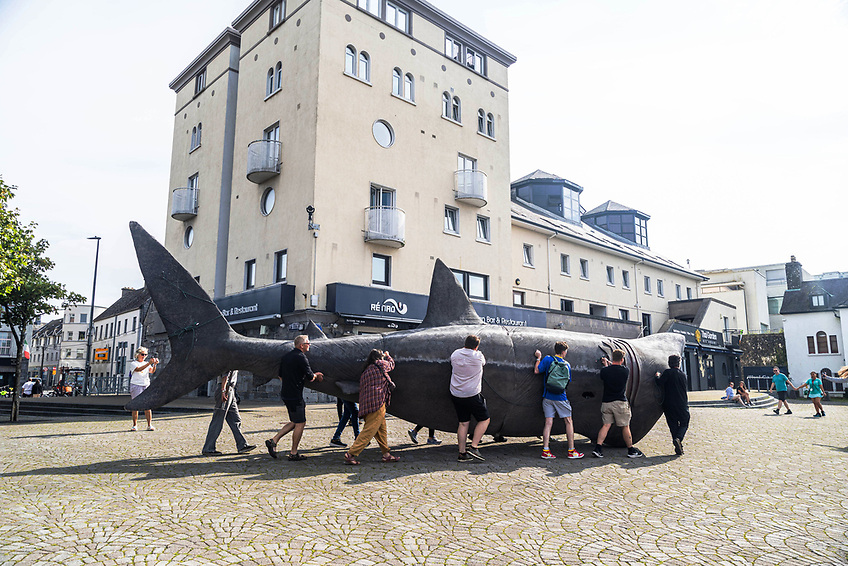
A 'shark' was paraded through Galway to the Spanish Arch to highlight the upcoming international event, where scientists, researchers, and shark enthusiasts from around the world will gather in the city this Friday.

A 'shark' was walked through Galway to be displayed at the Spanish Arch to draw attention to the international gathering of scientists, researchers and shark enthusiasts from around the world this Friday in the city.

The 10.6 metre model was specially commissioned for the International Basking Shark Conference at the Atlantic Technological University. Scientists, researchers and shark enthusiasts from around the world will gather for the event co-hosted by the Irish Basking Shark Group, Irish Whale and Dolphin Group and the National Parks and Wildlife Service. The conference aims to share the latest research findings on basking sharks, exchange ideas and set ambitious goals for the conservation of this species at a global scale

Thirty speakers from Ireland, the UK, the United States, Canada, Brazil, France, Norway, New Zealand and Japan are scheduled to deliver presentations, lead workshops and collaborate on strategies to better protect basking sharks. It is being held 16 years after an initial Irish Basking Shark Seminar in Donegal in 2009, where the Irish Basking Shark Group was formed to conduct research to better inform protection and management of the gentle marine giants. The conference will include a session sponsored by Fair Seas exploring Marine Protected Areas for basking sharks. There will be a series of free events, including headland watches, kayaking, draw-along sessions, rockpooling, art instalments, talks, traditional Irish music and film screenings, celebrating basking sharks and Ireland's marine biodiversity. The conference will be followed by an Ocean Literacy Day on Achill Island on Sunday, August 31.. There will be a series of free events, including headland watches, kayaking, draw-along sessions, rockpooling, art instalments, talks, traditional Irish music and film screenings, all celebrating basking sharks and Ireland's marine biodiversity. All are welcome at this event, which will run from 9 am to 5 pm, whatever the weather.

Basking sharks are the second largest fish in the ocean and are a familiar sight along Ireland's west coast between April and October, with breaching individuals spotted off the coast of Clare in recent weeks.

Emilie De Loose, IWDG conference organiser said, "Ireland is a hot spot for basking sharks and is one of the best places in the world to see them. There have been incredible sightings of basking sharks off our coast recently and we're continuing to learn more about these fascinating creatures. This international conference is an opportunity for experts to share knowledge and to work together to ensure their protection. In 2022, the basking shark became the first fish to gain legal protection in Ireland. Even though we no longer hunt these gentle giants and some populations are showing signs of recovery, there are still risks, pressures and threats that we need to manage."

The basking shark sculpture was commissioned by the Irish Basking Shark Group and Fair Seas and supported by the Heritage Council. It was located at the Spanish Arch as part of Heritage Week. It has now been moved to ATU ahead of the conference. It was created by well-known prop-maker Tommy Casby of Macnas in Galway.

The conference is open to scientists and non-scientists. Pre-registration is closed, On-site tickets will be available for €160. An Ocean Literacy Day on Achill Island is free and open to all. More information here 

Tom MacSweeney

About The Author

Tom MacSweeney

Email The Author

Tom MacSweeney writes a column for Afloat.ie. He is former RTE Marine Correspondent/Presenter of Seascapes and has a monthly Seascapes Podcast on the Community Radio Network and Podcast services

We've got a favour to ask

More people are reading Afloat.ie than ever thanks to the power of the internet but we're in stormy seas because advertising revenues across the media are falling fast. Unlike many news sites, we haven't put up a paywall because we want to keep our marine journalism open.

Afloat.ie is Ireland's only full-time marine journalism team and it takes time, money and hard work to produce our content.

So you can see why we need to ask for your help.

If everyone chipped in, we can enhance our coverage and our future would be more secure. You can help us through a small donation. Thank you.

Direct Donation to Afloat button

Sharks in Irish waters

Irish waters are home to 71 species of shark, skates and rays, 58 of which have been studied in detail and listed on the Ireland Red List of Cartilaginous fish. Irish sharks range from small Sleeper sharks, Dogfish and Catsharks, to larger species like Frilled, Mackerel and Cow sharks, all the way to the second largest shark in the world, the Basking shark. 

Irish waters provide a refuge for an array of shark species. Tralee Bay, Co. Kerry provides a habitat for several rare and endangered sharks and their relatives, including the migratory tope shark, angel shark and undulate ray. This area is also the last European refuge for the extremely rare white skate. Through a European Maritime and Fisheries Fund (EMFF) project, Marine Institute scientists have been working with fishermen to assess the distribution, diversity, and monthly relative abundance of skates and rays in Tralee, Brandon and Dingle Bays.

“These areas off the southwest coast of Ireland are important internationally as they hold some of the last remaining refuges for angel shark and white skate,” said Dr Maurice Clarke of the Marine Institute. “This EMFF project has provided data confirming the critically endangered status of some species and provides up-to-date information for the development of fishery measures to eliminate by-catch.” 

Irish waters are also home to the Black Mouthed Catshark, Galeus melastomus, one of Ireland’s smallest shark species which can be found in the deep sea along the continental shelf. In 2018, Irish scientists discovered a very rare shark-nursery 200 nautical miles off the west coast by the Marine Institute’s ROV Holland 1 on a shelf sloping to 750 metres deep. 

There are two ways that sharks are born, either as live young or from egg casings. In the ‘case’ of Black Mouthed Catsharks, the nursery discovered in 2018, was notable by the abundance of egg casings or ‘mermaid’s purses’. Many sharks, rays and skate lay eggs, the cases of which often wash ashore. If you find an egg casing along the seashore, take a photo for Purse Search Ireland, a citizen science project focusing on monitoring the shark, ray and skate species around Ireland.

Another species also found by Irish scientists using the ROV Holland 1 in 2018 was a very rare type of dogfish, the Sail Fin Rough Shark, Oxynotus paradoxus. These sharks are named after their long fins which resemble the trailing sails of a boat, and live in the deep sea in waters up to 750m deep. Like all sharks, skates and rays, they have no bones. Their skeleton is composed of cartilage, much like what our noses and ears are made from! This material is much more flexible and lighter than bone which is perfect for these animals living without the weight of gravity.

Throughout history sharks have been portrayed as the monsters of the sea, a concept that science is continuously debunking. Basking sharks were named in 1765 as Cetorhinus maximus, roughly translated to the ‘big-nosed sea monster’. Basking sharks are filter feeders, often swimming with their mouths agape, they filter plankton from the water.

They are very slow moving and like to bask in the sun in shallow water and are often seen in Irish waters around Spring and early Summer. To help understand the migration of these animals to be better able to understand and conserve these species, the Irish Basking Shark Group have tagged and mapped their travels.

Remarkably, many sharks like the Angel Shark, Squatina squatina have the ability to sense electricity. They do this via small pores in their skin called the ‘Ampullae of Lorenzini’ which are able to detect the tiny electrical impulses of a fish breathing, moving or even its heartbeat from distances of over a kilometre! Angel sharks, often referred to as Monkfish have a distinctively angelic shape, with flattened, large fins appearing like the wings of an angel. They live on the seafloor in the coastal waters of Ireland and much like a cat are nocturnal, primarily active at night.

The intricate complexity of shark adaptations is particularly noticeable in the texture of their skin. Composed of miniscule, perfectly shaped overlapping scales, the skin of shark provides them with protection. Often shark scales have been compared to teeth due to their hard enamel structure. They are strong, but also due to their intricate shape, these scales reduce drag and allow water to glide past them so that the shark can swim more effortlessly and silently. This natural flawless design has been used as inspiration for new neoprene fabric designs to help swimmers glide through the water. Although all sharks have this feature, the Leafscale Gulper Shark, Centrophorus squamosus, found in Ireland are specifically named due to the ornate leaf-shape of their scales.





















