



























The Royal Irish Yacht Club has never lacked for history, prestige or sailing achievement. From its landmark clubhouse overlooking Dún Laoghaire Harbour to a roll of members that includes Daniel O’Connell and the ocean voyager Conor O’Brien, it has long occupied a prominent position in Irish yachting. But as the club celebrates its 195th anniversary, its next five years could be every bit as interesting as the nearly two centuries that have gone before.
With its first woman Commodore, Winifred Kelliher, at the helm, the Royal Irish has enjoyed a busy anniversary season, celebrated success on Dublin Bay and at international championships, and begun laying the groundwork for its bicentenary in 2031. The Six Metre World Championships are already secured, discussions are under way about a possible transatlantic race, and an international Classics Regatta is among the ambitions.
For Kelliher, seven months into her term, the significance of becoming the club’s first female Commodore is about considerably more than a personal milestone.
“I’m now seven months into my term as Commodore and it’s been both a huge honour and very satisfying,” she told Afloat. “I have been particularly struck by the warmth and support of the members.”
She is equally clear that her election represents recognition of the wider contribution women have made to the Royal Irish.
“Women members play key roles in the running and routine of the Club and more widely in the sailing community, therefore the election of a female commodore by our members, male and female was a vote for our female members collectively.”
It is a notable development for a club founded in 1831, although Kelliher is more concerned with what the Royal Irish does next than with dwelling on the historic nature of her appointment.
A 195th Anniversary Season
The anniversary has provided an opportunity to bring the club’s sailing and social activities together, with a week of commemorative events sponsored by Drumshanbo Gunpowder Irish Gin. The programme included the Royal Irish Classics Regatta and the club’s own annual regatta, both continuing traditions that have helped make the clubhouse and its waterfront a focal point of Dublin Bay sailing.
“2026 was undoubtedly a bumper year, underpinning the Club’s reputation for attracting and hosting world class events,” Kelliher says.
“The 195th Anniversary has given rise to an energy and dynamic across the Club and it is an incredible time to be part of that.”
She has worked alongside Vice Commodore Joe Conway, Rear Commodore Sailing Michael Tyrrell and Rear Commodore House Aoife Nolan Beattie on the club’s programme.
 Anniversary Leadership: Royal Irish Yacht Club Commodore Winifred Kelliher and her fellow Flag Officers Joe Conway, Michael Tyrrell and Aoife Nolan Beattie are guiding the club through its 195th anniversary season and preparations for its bicentenary in 2031. Photo: Royal Irish Yacht Club
Kelliher says the Flag Officers have steered through two initiatives intended to prepare the Royal Irish for the future, both receiving membership support. One confirmed change is the decision to reduce the minimum Cadet membership age from 18 to 16, part of a broader effort to develop younger members.
The anniversary celebrations also follow another significant recognition: the Royal Irish was named Afloat’s MG Motor Sailing Club of the Year for 2025, its second such award since 2016. The award followed a 2024 programme that included hosting the Irish J-Cup, ICRA National Championships and IRC European Championships.
 Anniversary Racing: The Royal Irish’s 195th anniversary celebrations included its Classics Regatta (above) and annual club regatta, supported by Drumshanbo Gunpowder Irish Gin.
The Clubhouse and Its History
For all the attention given to racing, Kelliher places considerable importance on the character of the Royal Irish itself.
“At the heart of the membership is a shared passion for an enduring Club that combines heritage and tradition with a pragmatism that will sustain us into our third century.”
She describes the ambition as maintaining a club that is a “home from home” for members, while recognising that younger sailors will determine much of its future.
That balance between preservation and change is especially apparent in the clubhouse, designed by John Skipton Mulvany and completed around 1850. The club’s history has also been explored in a recent book on the Royal Irish and modern Ireland.
“Conservation of the Club is vital. When you enter the Club it evokes, for me at least, a sense of history and how important its preservation is.”
Kelliher describes the building as the first purpose-built yacht clubhouse in the world, drawing attention to its tall sash windows, drawing and dining rooms, open fires, paintings, billiard room and terrace overlooking the harbour.
“The Club has survived wars, global and financial crises and pandemics and is a mirror on Irish history.”
The club’s historic membership reflects that wider story. Alongside the Marquess of Anglesey and Daniel O’Connell, Kelliher recalls Conor O’Brien, whose voyages made him one of Ireland’s best-known ocean sailors, and later figures including Tim Goodbody, Tom Roche, Ken Rohan, the late Tom Power and Michael Boyd.
The founding Commodore, the Marquess of Anglesey, also figures in the early history of the silver trophy that subsequently became the America’s Cup, having presented it to the Royal Yacht Squadron in 1848.
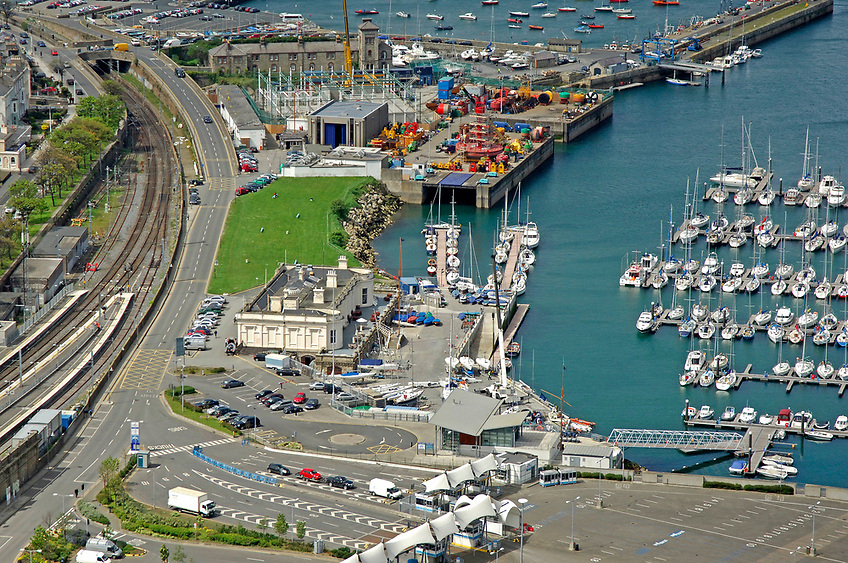 Architectural Legacy: The historic Royal Irish Yacht Club clubhouse, designed by John Skipton Mulvany and completed in 1850, occupies a prominent position on the waterfront in the heart of Dún Laoghaire Harbour, overlooking the town's marina and the wider harbour. The building remains central to the club's identity as it approaches its bicentenary in 2031. Photo: RIYC
Another historic connection is Conor O’Brien’s circumnavigation aboard the 42-foot Saoirse. O’Brien departed from the Royal Irish on 20 June 1923, sailing around the world south of the great capes and returning to the same clubhouse on 20 June 1925, exactly two years later. The voyage remains an important chapter in Irish ocean-sailing history.
 Ocean Legacy: Conor O’Brien sailed Saoirse around the world between 1923 and 1925, departing from and returning to the Royal Irish Yacht Club
The Royal Irish’s wine cellar is another element of its heritage that Kelliher believes deserves recognition. Its collection of en primeur wines, she says, is a valuable club asset that also offers members considerable value.
Preserving these features, however, does not mean treating the clubhouse as a museum. Kelliher sees its continuing use by sailors and members as central to its survival.
The Big-Boat Club
The Royal Irish is particularly associated with cruiser racing on Dublin Bay, and its facilities reflect that involvement.
“We are also known in Dun Laoghaire as the big boat Club,” Kelliher says.
A major investment in recent years was the club’s 90-ton Liebherr crane, capable of lifting boats weighing up to 23 tons.
 Heavy Lifting: The Royal Irish Yacht Club's historic clubhouse at Dún Laoghaire Harbour, with its 90-ton Liebherr crane on the left. Capable of lifting yachts weighing up to 23 tonnes, the crane is a key part of the club's facilities for hosting major national and international sailing championships. Photo: Afloat
“This investment has underpinned our ability to attract and plan major national and international sailing events.”
The Royal Irish’s position within Dún Laoghaire Harbour and its boat-handling facilities make it an important base for larger yachts racing on Dublin Bay, but the evidence of its competitive activity is found in the results.
At the 2026 Dublin Bay Sailing Club prizegiving, Royal Irish members and boats secured three of the six Premier Awards. Playtime, sailed by Johnnie Phillips, John Curtis and Joris Heeze, received the Waterhouse Shield as the most successful yacht in handicap racing. Yikes, representing Team Yikes, won the George Arthur Newsom Cup for the most successful yacht in one-design racing.
The Brendan Ebril Memorial Cup, recognising those who best reflect the spirit of Dublin Bay sailing, went to Royal Irish members Hal Sisk and Fionán de Barra.
The results give the club a measurable share of DBSC’s principal honours in its anniversary year, alongside the regular involvement of Royal Irish yachts in the cruiser divisions.
 Premier Honours: Playtime’s Waterhouse Shield was one of three DBSC Premier Awards secured by Royal Irish members and boats in 2026. Photo: Afloat
Keeping Dublin Bay Sailing Accessible
Kelliher does not regard the health of sailing on Dublin Bay as something that can be taken for granted.
“Dublin Bay is known as the cradle of yacht racing and its popularity among sailors endures, albeit not without its challenges as lifestyles and time commitments change.”
She points to changing patterns of work, leisure and sporting participation, as well as the cost of taking part.
“Active lifestyles are now the norm and there is a strong emphasis on sports and outdoors in particular and that in turn creates opportunities but also challenges in terms of how and when people choose to sail and with whom and also the question of affordability.”
For the Royal Irish, one response is to provide a clearer route into sailing for people who may not already own a boat or belong to an established racing crew. The club’s adult sailing courses have been oversubscribed, attracting both newcomers and people returning to the sport.
“It’s a positive sign that our Adult Sailing courses are oversubscribed with both first time and returning sailors and crucially we ensure that they are then supported into crewing on other boats potentially with a view to future boat ownership.”
That progression matters. A course is an introduction, but a regular place aboard a racing boat can turn a short-term interest into lasting participation. The club’s schools sailing programme has also been extended to meet demand.
At the same time, Kelliher identifies team racing as an increasingly important means of keeping young sailors involved during their college years.
“Team Racing is enjoying a renaissance and a renewed impetus across the third level colleges. Although this extends beyond Dublin Bay its attracting and keeping younger sailors engaged at a pivotal time in their lives.”
The Royal Irish has established a sailing pathway covering the 12-to-30 age group, intended to encourage participation at different stages, from school and Cadet sailing to adult racing.
Kelliher believes the club has moved a considerable distance from its historically male-dominated membership towards a broader approach to participation.
“The RIYC has over time evolved and has moved from a traditional male dominated Club typical of a particular era, to being all-encompassing with a clear mission to foster and nurture our younger sailors.”
The reduction in Cadet membership age from 18 to 16 is one element of that policy, but the more substantial undertaking is to keep sailors involved as their circumstances change.
The importance of schools sailing was illustrated by the 2026 Leinster Schools Team Racing Championships, when St Andrew’s College won its fifth successive title at the Royal Irish, ahead of the Institute of Education and Kilkenny College.
 Five in a Row: St Andrew’s College secured a fifth successive Leinster Schools Team Racing title as 16 teams competed at the Royal Irish Yacht Club. Photo: Rob Micallef
Lessons from the Dublin Bay 21s and Dragons
Kelliher also sees developments in traditional keelboat classes as evidence that sailing does not always have to depend on individual boat ownership.
She points particularly to the restored Dublin Bay 21-footers, originally designed by Alfred Mylne in the early twentieth century to provide more affordable cruiser racing.
“The success for example of the Dublin Bay 21s has demonstrated clearly that collective involvement rather than ownership is gaining traction.”
Their return to the bay, she believes, suggests a model capable of attracting both newcomers and former sailors back onto the water. Rather than expecting each participant to finance and maintain a boat, collective involvement can distribute the commitment among a group.
A similar consideration applies to the club’s growing Dragon fleet.
“More recently we have seen our own Dragon fleet expand with affordability key and small crew numbers attracting younger sailors and owners.”
The class has particular personal significance for Kelliher. Her late father-in-law, Eddie Kelliher, was the Royal Irish’s first Olympian. She believes the renewed interest in Dragons would have pleased him.
 Shared Heritage: The restored Dublin Bay 21s Naneen (left) and Geraldine sail past the Forty Foot bathing place off Sandycove. The revival of the historic fleet demonstrates the collective ownership model that Royal Irish Yacht Club Commodore Winifred Kelliher believes can help make sailing more accessible. Photo: Afloat
The combination of established classes, new entrants and practical access to boats is central to her view of how Dublin Bay racing can continue to develop.
She also acknowledges the importance of the harbour’s facilities and management, specifically praising Tim Ryan, Harbour Operations Manager with Dún Laoghaire-Rathdown County Council, for his support.
“Dun Laoghaire has the most wonderful sailing facilities within easy reach of the city and the greater Dublin area,” she says, adding that the challenge is to make full use of those opportunities.
Racing Beyond Dublin Bay
The Royal Irish’s 2026 results have not been confined to its home waters. Kelliher regards the achievements of members racing nationally and internationally as important both for the individuals concerned and for the club’s ability to attract major championships.
“Many of our sailors are making or have made names and careers for themselves on the international circuit, nationally or as elite sailors and all out of the RIYC.”
She believes those sailors demonstrate to younger members that international competition can begin with ordinary club sailing in Dún Laoghaire.
“It serves as a testament to current and future generations that there is a world of opportunity and it starts with your home Club in Dun Laoghaire.”
 Welsh Triumph: Barry Cunningham's Royal Irish Yacht Club yacht Chimaera claimed the Welsh IRC Championship title in 2026, highlighting the club's racing successes beyond Dublin Bay during its 195th anniversary season. Photo: Afloat
Among the achievements she highlights are Barry Cunningham’s Chimaera, winner of the Welsh IRC title, and Halloween, associated with Inigo Strez and Declan Hayes. Austin Kenny and the Ram Jam J/80 team finished second at the UK Nationals in June, level on points with the winner.
In the SB20 class, Ger Dempsey, Colin Galavan and Arten Baskin finished 18th overall at the World Championships in Hyères, with Kelliher also highlighting fourth place in the Masters category for the Venuesworld campaign.
The Royal Irish also has sailors working professionally on the international circuit. Kelliher singles out Tim Goodbody Jnr and Aaron O’Grady as two whose services are in demand.
“Our RIYC sailors have demonstrated that they can hold their own beyond the bay and across different classes and fleets,” she says.
The range of those results, from handicap cruiser racing to J/80s and SB20s, illustrates the different opportunities available to sailors emerging from the club.
 World Championship Form: Royal Irish sailors Ger Dempsey, Colin Galavan and Arten Baskin finished 18th overall at the 2026 SB20 World Championship in Hyères. Photo: Afloat if using Dublin Bay image; João Saraiva Mendes
The Olympic Pathway
At the highest level, Kelliher identifies Fiachra Geraghty-McDonnell as one of the club’s sailors pursuing an Olympic campaign. Following his first Senior ILCA World Championships, he is building towards the World Sailing Championships in Brazil in January, with qualification for Los Angeles 2028 the longer-term objective.
Another Royal Irish sailor with an Olympic record is Saskia Tidey. Tidey is already a three-time Olympian. She represented Ireland at Rio 2016 before switching to Great Britain, competing at Tokyo 2020 and Paris 2024. She finished sixth in the women’s 49erFX at Tokyo.
Her change of national representation is part of her career history, but her beginnings in Dún Laoghaire and association with the Royal Irish remain relevant to the club’s record of producing international sailors. Kelliher includes Tidey among those with an eye on the Los Angeles Olympics in 2028.
 Olympic Ambitions: Royal Irish sailor Fiachra Geraghty-McDonnell is building towards the 2027 World Sailing Championships in Brazil with Los Angeles 2028 as a longer-term goal. Photo: Afloat
The younger generation is also represented in her account of the season. Royal Irish Cadet Tim Norwood secured bronze at the Melges Western Championships, while Georgia Goodbody produced strong performances for Trinity College on the team racing circuit.
Caoilinn Geraghty-McDonnell took the Leinster Schools team racing title, another achievement in a discipline Kelliher believes is increasingly important to retaining younger sailors.
In Dragons, Joey Bergin and Rian Geraghty-McDonnell finished fifth in the Corinthian division of the Edinburgh Cup aboard Denis Bergin’s Sir Ossis of the River. These results extend the club’s racing record beyond its cruiser fleet and include sailors at very different stages of their careers.
 Dragon Legacy: Joey Bergin and Rian Geraghty-McDonnell finished fifth in the Corinthian division of the Edinburgh Cup aboard Denis Bergin’s Sir Ossis of the River (above). Photo: Robert Bateman
The Volunteers Behind the Racing
Kelliher is emphatic about the people who make the club’s sailing programme possible.
“Without doubt it’s the volunteers; they are the lifeblood of the Club whether it is sailing or social.”
Running a national or international championship requires considerably more than a race committee on the water, particularly when events are scheduled close together.
“It is entirely what makes it possible to run a great championship whether regional, national or international and often back to back.”
She pays particular tribute to three race officers: Michael Tyrrell, the club’s Rear Commodore Sailing and an international race officer; Brian Matthews; and Mairéad Ní Cheallacháin.
“Our three race officers comprising international race officer Michael Tyrrell, Rear Commodore Sailing; Brian Matthews and Mairéad Ní Cheallacháin along with their support teams are just phenomenal. I am in awe of how they give so freely and tirelessly of their time.”
Her appreciation extends to the organisers whose work may be less visible to competitors. Therese Tyrrell coordinates volunteer groups for events. Fintan Cairns is associated with the long-running Turkey Shoot winter series, while Davie Ryan has reinvigorated the biennial Dún Laoghaire Sportsboat Championships.
MJ Geraghty, she says, was central to organising both the Irish Schools Sailing Team Racing National Championships and the Leinster Championships hosted by the Royal Irish.
These contributions are not limited to race management. Kelliher also mentions volunteers who arrange social programmes, conduct clubhouse tours and staff merchandise stands during championships.
The social side of hosting major events is particularly important to the Royal Irish’s programme, and the Commodore sees sponsorship as another essential component. She acknowledges the continued support of Drumshanbo Gunpowder Irish Gin, particularly Pat and Denise Rigney, whose backing was important to the 195th anniversary celebrations.
 Behind the Racing: Spirit of the Irish, the Royal Irish Yacht Club's dedicated committee vessel, plays a central role in supporting racing and championship events on Dublin Bay. Commodore Winifred Kelliher has paid tribute to the race officers, volunteers and organisers whose work aboard the vessel and ashore helped deliver the club's busy 195th anniversary sailing programme. Photo: Afloat
Running the Royal Irish as a Business
Behind the volunteer programme is a permanent staff responsible for the everyday operation of the club. Kelliher believes their contribution is easily overlooked.
“Behind the scenes at the RIYC there is a ‘no problem can do’ culture with an expertise that delivers time and again.”
She identifies General Manager Andrew Roberts, Sailing Manager Mark McGibney and bosun Miguel Walker, alongside longstanding staff members Club Secretary Sarah Breen and Catering Manager Maeve Daly. All have provided important support to the Flag Officers during a particularly active year.
“Running a Club is akin to running an SME and they have been invaluable.”
It is a practical observation about an organisation that must maintain a historic building, manage its waterfront facilities, provide sailing services and hospitality, and organise major events, while remaining accountable to its membership. That business-like approach is also evident in the planning now under way for the bicentenary.
The Road to 2031
The Royal Irish will celebrate its 200th anniversary in 2031, and preparations have already begun. Asked what she would most like the club to achieve by then, Kelliher’s answer begins with its long-term viability.
“In short a future proofed, sustainable Club with a solid and expanded membership base.”
She wants the Royal Irish to continue attracting major international championships, supported by the social programmes for which it is known. The most substantial confirmed event on the bicentenary programme is the Six Metre World Championships.
“For our bicentenary we have already secured the 6 Metre World Championships.”
There is also a more ambitious possibility under discussion.
“We are also working on a transatlantic race with Ron O’Hanley, Vice Commodore of the New York Yacht Club and also a member of the RIYC.”
Kelliher hopes an international Classics Regatta can form another part of the programme.
“I am hoping we can build into the programme a Classic Regatta that will attract both local and international participation.”
The distinction between those plans matters: the Six Metre Worlds are secured, while the transatlantic race and Classics Regatta remain proposals being developed.
The club is also examining the physical requirements of its future.
“With sustainability uppermost we will shortly undertake an Infrastructure Survey to anticipate and future proof the Club and to identify key projects.”
That exercise will sit alongside a major survey of the membership, recently completed, which Kelliher says will inform the direction of future initiatives.
“We have also just completed a major survey of the Membership and their feedback will be critical to underpinning and providing the impetus and support for any new initiatives.”
For a club with a protected architectural legacy, substantial sailing infrastructure and a membership spanning generations, these decisions will have consequences well beyond the bicentenary celebrations themselves.
Kelliher’s priorities suggest that the Royal Irish’s 200th anniversary will be judged not simply by the events it hosts, but by the condition in which it enters its third century: its membership, its facilities and its ability to bring new sailors into the sport.
At 195, the Royal Irish Yacht Club has plenty of history to celebrate. But with its bicentenary approaching, it is the next generation of sailors who will help write the next chapter.