
























Menu

Ireland's sailing, boating & maritime magazine

RBC Brewin Dolphin proudly supporting Afloat and Irish Boating

Marine Institute Banner Advert 2024

Bumpy Snailfish - New Deep Sea Fish Identified by Scientists

20th September 2025
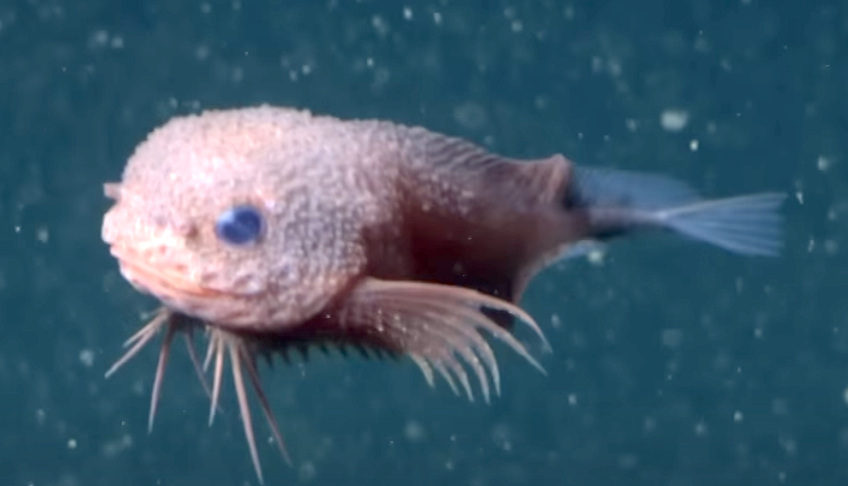
Researchers documenting the bumpy snailfish specimen
Researchers from MBARI documented the newly discovered bumpy snailfish at a depth of over 3,000 metres off the Californian coast. See vid below. Credit: MBARI via YouTube

A deep-sea fish has been identified by US scientists which was previously unknown to science.

The bumpy snailfish (Careproctus colliculi) was first encountered with advanced underwater technology in 2019, swimming just above the seafloor.

The Monterey Bay Aquarium Research Institute (MBARI) has now confirmed that the fish with a distinctive pink colour, pectoral fins and long fin rays, along with a unique bumpy texture, is a new species.

It has been recorded along with two other snailfish for the abyssal seafloor off California by a team of researchers from the State University of New York at Geneseo (SUNY Geneseo), scientists from the University of Montana and the University of Hawaiʻi at Mānoa in the scientific journal Ichthyology and Herpetology.

“MBARI seeks to make ocean exploration more accessible by sharing our data and technology with our peers in the science community,” said Steven Haddock, a senior scientist at MBARI and the expedition leader who encountered the bumpy snailfish.

“We welcomed the opportunity to collaborate with researchers from SUNY Geneseo to expand our understanding of life in the deep ocean, especially since documenting deep-sea biodiversity is critical to detecting any changes that may be occurring in this environment,” he said.

MBARI says that snailfishes belong to the family Liparidae, and typically have a large head, jelly-like body covered in loose skin, and narrow tail.

“Many snailfish species have a disk on their belly that allows them to grip the seafloor or hitchhike on larger animals, such as deep-sea crabs. Shallow-water snailfishes often cling to rocks and seaweed, curling up like a snail,” it says.

“Scientists have described more than 400 different species of snailfish worldwide. These fishes make their homes in a variety of ocean habitats, from shallow tide pools to deep-sea trenches. In fact, a snailfish holds the record for the deepest-dwelling fish,” MBARI says.

Haddock and his team were exploring the outer reaches of Monterey Canyon, approximately 100 kilometres (62 miles) offshore of Central California, with MBARI’s remotely operated vehicle Doc Ricketts at a depth of 3,268 meters (10,722 feet) when they observed the small snailfish swimming above the abyssal seafloor.

MBARI researchers collected the individual—an adult female 9.2 cms (3.6 inches) long—for further study in the laboratory.

“With features unlike other deep-sea snailfishes that MBARI had encountered offshore of California, Haddock reached out to Gerringer for more detailed analysis. MBARI frequently collaborates with expert taxonomists to review footage and specimens. These partnerships offer fresh perspectives that often spark new discoveries,” MBARI says.


Afloat.ie Team

About The Author

Afloat.ie Team

Email The Author

Afloat.ie is Ireland's dedicated marine journalism team.

Have you got a story for our reporters? Email us here.

We've got a favour to ask

More people are reading Afloat.ie than ever thanks to the power of the internet but we're in stormy seas because advertising revenues across the media are falling fast. Unlike many news sites, we haven't put up a paywall because we want to keep our marine journalism open.

Afloat.ie is Ireland's only full-time marine journalism team and it takes time, money and hard work to produce our content.

So you can see why we need to ask for your help.

If everyone chipped in, we can enhance our coverage and our future would be more secure. You can help us through a small donation. Thank you.

Direct Donation to Afloat button

Marine Science Perhaps it is the work of the Irish research vessel RV Celtic Explorer out in the Atlantic Ocean that best highlights the essential nature of marine research, development and sustainable management, through which Ireland is developing a strong and well-deserved reputation as an emerging centre of excellence. From Wavebob Ocean energy technology to aquaculture to weather buoys and oil exploration these pages document the work of Irish marine science and how Irish scientists have secured prominent roles in many European and international marine science bodies.


At A Glance – Ocean Facts

  • 71% of the earth’s surface is covered by the ocean
  • The ocean is responsible for the water cycle, which affects our weather
  • The ocean absorbs 30% of the carbon dioxide added to the atmosphere by human activity
  • The real map of Ireland has a seabed territory ten times the size of its land area
  • The ocean is the support system of our planet.
  • Over half of the oxygen we breathe was produced in the ocean
  • The global market for seaweed is valued at approximately €5.4 billion
  • · Coral reefs are among the oldest ecosystems in the world — at 230 million years
  • 1.9 million people live within 5km of the coast in Ireland
  • Ocean waters hold nearly 20 million tons of gold. If we could mine all of the gold from the ocean, we would have enough to give every person on earth 9lbs of the precious metal!
  • Aquaculture is the fastest growing food sector in the world – Ireland is ranked 7th largest aquaculture producer in the EU
  • The Atlantic Ocean is the second largest ocean in the world, covering 20% of the earth’s surface. Out of all the oceans, the Atlantic Ocean is the saltiest
  • The Pacific Ocean is the largest ocean in the world. It’s bigger than all the continents put together
  • Ireland is surrounded by some of the most productive fishing grounds in Europe, with Irish commercial fish landings worth around €200 million annually
  • 97% of the earth’s water is in the ocean
  • The ocean provides the greatest amount of the world’s protein consumed by humans
  • Plastic affects 700 species in the oceans from plankton to whales.
  • Only 10% of the oceans have been explored.
  • 8 million tonnes of plastic enter the ocean each year, equal to dumping a garbage truck of plastic into the ocean every minute.
  • 12 humans have walked on the moon but only 3 humans have been to the deepest part of the ocean.

(Ref: Marine Institute)

Featured Sailing School

INSS sidebutton

Featured Clubs

dbsc mainbutton
Howth Yacht Club
Kinsale Yacht Club
National Yacht Club
Royal Cork Yacht Club
Royal Irish Yacht club

Featured Brokers

leinster sidebutton

Featured Webcams

Featured Associations

ISA sidebutton
ICRA
isora sidebutton

Featured Marinas

dlmarina sidebutton

Featured Chandleries

CHMarine Afloat logo
https://afloat.ie/resources/marine-industry-news/viking-marine

Featured Sailmakers

northsails sidebutton
uksails sidebutton
watson sidebutton

Featured Blogs

W M Nixon - Sailing on Saturday
podcast sidebutton
BSB sidebutton
wavelengths sidebutton
 

Please show your support for Afloat by donating




















