
























Menu

Ireland's sailing, boating & maritime magazine

RBC Brewin Dolphin proudly supporting Afloat and Irish Boating

Marine Institute Banner Advert 2024

UCC Tyndall Institute Develops BioSensors To Detect Harmful "Forever Chemicals"

12th December 2025
“Dr
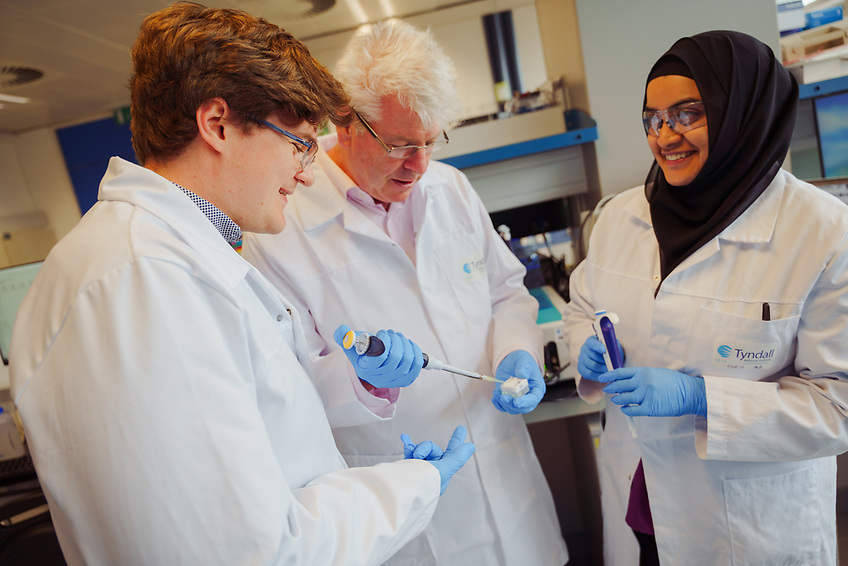
Dr Richard Murray, Postdoctoral Researcher, Sana Muzaffar, PhD Student, and Professor Alan O’Riordan (centre), Head of the Precision Electrochemical Nanosensor Research Group at Tyndall National Institute

A new EU-funded project led by UCC’s Tyndall National Institute is developing cutting-edge biosensors that use bacteria to detect harmful “forever chemicals” in the marine and terrestrial environment.

“Forever chemicals” include a group of persistent pollutants known as PFAS (per- and polyfluoroalkyl substances) found in everyday items.

They are increasingly found in our environment and pose serious risks to human health and ecosystems.

Their presence threatens the integrity of natural resources and has been linked to cancer, high cholesterol, reproductive issues, hormonal disruption, and weakened immunity.

Funded by the European Commission, the BIOSENSEI project brings together ten partners from across Europe to create real-time, multiplexed, end-to-end biosensors that will detect “forever chemicals” in the environment.

BIOSENSEI is developing scalable biosensors for water and soil applications.

These sensors will use adapted microbes to detect pollutants and will be deployed in “real world settings”, the researchers say.

The cellular responses will be captured by silicon chip-based transducers, enabling highly sensitive and reliable detection.

Tyndall is a leading European deep-tech research centre in integrated ICT (Information and Communications Technology) materials, devices, circuits and systems and a research flagship of UCC.


Afloat.ie Team

About The Author

Afloat.ie Team

Email The Author

Afloat.ie is Ireland's dedicated marine journalism team.

Have you got a story for our reporters? Email us here.

We've got a favour to ask

More people are reading Afloat.ie than ever thanks to the power of the internet but we're in stormy seas because advertising revenues across the media are falling fast. Unlike many news sites, we haven't put up a paywall because we want to keep our marine journalism open.

Afloat.ie is Ireland's only full-time marine journalism team and it takes time, money and hard work to produce our content.

So you can see why we need to ask for your help.

If everyone chipped in, we can enhance our coverage and our future would be more secure. You can help us through a small donation. Thank you.

Direct Donation to Afloat button

Marine Science Perhaps it is the work of the Irish research vessel RV Celtic Explorer out in the Atlantic Ocean that best highlights the essential nature of marine research, development and sustainable management, through which Ireland is developing a strong and well-deserved reputation as an emerging centre of excellence. From Wavebob Ocean energy technology to aquaculture to weather buoys and oil exploration these pages document the work of Irish marine science and how Irish scientists have secured prominent roles in many European and international marine science bodies.


At A Glance – Ocean Facts

  • 71% of the earth’s surface is covered by the ocean
  • The ocean is responsible for the water cycle, which affects our weather
  • The ocean absorbs 30% of the carbon dioxide added to the atmosphere by human activity
  • The real map of Ireland has a seabed territory ten times the size of its land area
  • The ocean is the support system of our planet.
  • Over half of the oxygen we breathe was produced in the ocean
  • The global market for seaweed is valued at approximately €5.4 billion
  • · Coral reefs are among the oldest ecosystems in the world — at 230 million years
  • 1.9 million people live within 5km of the coast in Ireland
  • Ocean waters hold nearly 20 million tons of gold. If we could mine all of the gold from the ocean, we would have enough to give every person on earth 9lbs of the precious metal!
  • Aquaculture is the fastest growing food sector in the world – Ireland is ranked 7th largest aquaculture producer in the EU
  • The Atlantic Ocean is the second largest ocean in the world, covering 20% of the earth’s surface. Out of all the oceans, the Atlantic Ocean is the saltiest
  • The Pacific Ocean is the largest ocean in the world. It’s bigger than all the continents put together
  • Ireland is surrounded by some of the most productive fishing grounds in Europe, with Irish commercial fish landings worth around €200 million annually
  • 97% of the earth’s water is in the ocean
  • The ocean provides the greatest amount of the world’s protein consumed by humans
  • Plastic affects 700 species in the oceans from plankton to whales.
  • Only 10% of the oceans have been explored.
  • 8 million tonnes of plastic enter the ocean each year, equal to dumping a garbage truck of plastic into the ocean every minute.
  • 12 humans have walked on the moon but only 3 humans have been to the deepest part of the ocean.

(Ref: Marine Institute)

Featured Sailing School

INSS sidebutton

Featured Clubs

dbsc mainbutton
Howth Yacht Club
Kinsale Yacht Club
National Yacht Club
Royal Cork Yacht Club
Royal Irish Yacht club

Featured Brokers

leinster sidebutton

Featured Webcams

Featured Associations

ISA sidebutton
ICRA
isora sidebutton

Featured Marinas

dlmarina sidebutton

Featured Chandleries

CHMarine Afloat logo
https://afloat.ie/resources/marine-industry-news/viking-marine

Featured Sailmakers

northsails sidebutton
uksails sidebutton
watson sidebutton

Featured Blogs

W M Nixon - Sailing on Saturday
podcast sidebutton
BSB sidebutton
wavelengths sidebutton
 

Please show your support for Afloat by donating




















