
























Menu

Ireland's sailing, boating & maritime magazine

RBC Brewin Dolphin proudly supporting Afloat and Irish Boating

Marine Institute Banner Advert 2024

SmartBay Underwater Observatory to Play Central Role in Next Phase of Europe’s ‘Digital Twin of the Ocean’ Initiative

30th January 2026
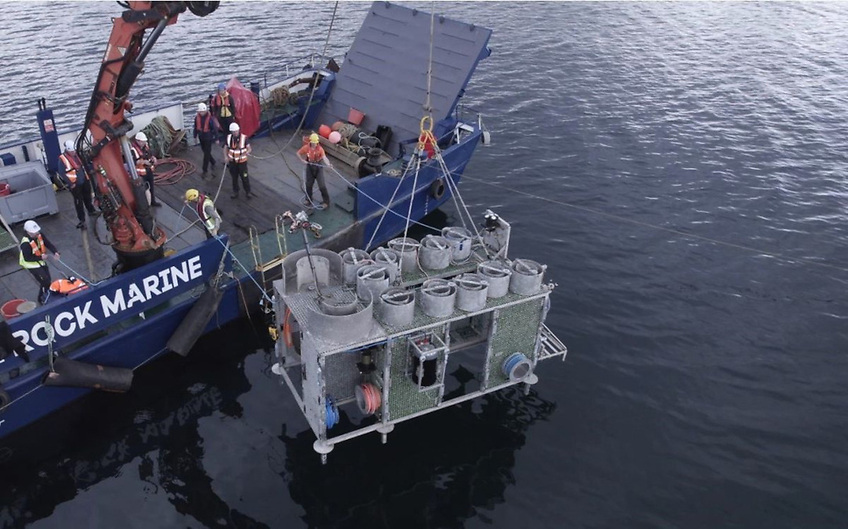
The SmartBay cabled underwater observatory being deployed in Galway Bay

A new international study has proposed an operational strategy to advance the Digital Twin of the Ocean initiative for European waters into an active, adaptive monitoring system.

The SmartBay cabled underwater observatory, operated by the Marine Institute, already generates data for a digital twin of Galway Bay and will play an important role in this development.

The Digital Twin of the Ocean (DTO) is a digital representation of a specific marine area, designed to improve understanding of ocean conditions and the impacts of human activities for scientists, policymakers and the public.

Advancing DTO is now a strategic priority for Europe, supported by European Commission investments under the EU Mission to Restore our Ocean and Waters.

DTO systems integrate many different types of data, including environmental measurements, citizen observations, fisheries data and scientific ocean surveys.

Data from a given marine region is combined into a single spatio-temporal dataset, and tagged with metadata such as source platform or sensor, latitude, longitude and depth, and aligned in time.

“This approach allows us to track how key elements of marine ecosystems, such as species abundance and biomass, change over time in relation to other factors like oceanographic and meteorological conditions, and to analyse how these variables change,” says Jacopo Aguzzi, senior researcher at the Instituto de Ciencias del Mar (ICM-CSIC), Spain and lead author of the study.

Published in the journal Ecological Informatics, the study outlines how networks of fixed and mobile robotic platforms can collect and integrate data to support adaptive monitoring.

The SmartBay observatory ready for redeployment after maintenance worksThe SmartBay observatory ready for redeployment after maintenance works

This approach is already being implemented through the European Digi4Eco project (Digital Twin-sustained 4D ecological monitoring of restoration in fishery-depleted areas), funded by the European Commission.

Two cabled underwater observatories — OBSEA in Spain and SmartBay in Ireland — are providing continuous biological and environmental observations, demonstrating the value of combining long-term monitoring with advanced spatio-temporal modelling.

“Data collected by SmartBay’s cabled infrastructure, including high-resolution imaging and multi-parameter sensors, form the basis of a four-dimensional Digital Twin of Galway Bay,” says Paul Gaughan, scientific and technical officer with the Marine Institute’s Research Infrastructures Team.

“This enables real-time behavioural monitoring of Norway lobster (Nephrops norvegicus), supported by AI-driven spatio-temporal analysis to better understand ecological responses and support restoration in fishery-depleted areas.”

At the SmartBay site in Galway Bay, researchers are using autonomous imaging systems to study how individual Norway lobsters interact with their burrows over time. These observations help track behavioural patterns and improve the precision of stock assessments, supporting more informed fisheries management.

Both SmartBay and OBSEA are part of EMSO ERIC (European Multidisciplinary Seafloor and Water-column Observatories), a pan-European research infrastructure that integrates fixed observatories with mobile technologies such as autonomous underwater vehicles (AUVs), remotely operated vehicles (ROVs), seabed crawlers and stand-alone landers, supported by research vessels to achieve wide spatial coverage.

“By linking digital twins across EMSO regional facilities, we strengthen data interoperability, predictive modelling and access to harmonised datasets, accelerating marine research and policy support at European scale,” adds Rick Officer, chief executive of the Marine Institute.

“Digital twins are becoming essential for understanding how ecosystems respond to restoration measures and climate pressures,” says Prof Joaquín del Río, director of the Development Center of Remote Acquisition and Information Processing Systems (SARTI) at UPC and coordinator of OBSEA. “Through Digi4Eco, OBSEA contributes long-term datasets and technology testbeds that help translate science into practical conservation action, while also driving new engineering solutions for intelligent and sustainable ocean observation systems.”


Afloat.ie Team

About The Author

Afloat.ie Team

Email The Author

Afloat.ie is Ireland's dedicated marine journalism team.

Have you got a story for our reporters? Email us here.

We've got a favour to ask

More people are reading Afloat.ie than ever thanks to the power of the internet but we're in stormy seas because advertising revenues across the media are falling fast. Unlike many news sites, we haven't put up a paywall because we want to keep our marine journalism open.

Afloat.ie is Ireland's only full-time marine journalism team and it takes time, money and hard work to produce our content.

So you can see why we need to ask for your help.

If everyone chipped in, we can enhance our coverage and our future would be more secure. You can help us through a small donation. Thank you.

Direct Donation to Afloat button

Marine Science Perhaps it is the work of the Irish research vessel RV Celtic Explorer out in the Atlantic Ocean that best highlights the essential nature of marine research, development and sustainable management, through which Ireland is developing a strong and well-deserved reputation as an emerging centre of excellence. From Wavebob Ocean energy technology to aquaculture to weather buoys and oil exploration these pages document the work of Irish marine science and how Irish scientists have secured prominent roles in many European and international marine science bodies.


At A Glance – Ocean Facts

  • 71% of the earth’s surface is covered by the ocean
  • The ocean is responsible for the water cycle, which affects our weather
  • The ocean absorbs 30% of the carbon dioxide added to the atmosphere by human activity
  • The real map of Ireland has a seabed territory ten times the size of its land area
  • The ocean is the support system of our planet.
  • Over half of the oxygen we breathe was produced in the ocean
  • The global market for seaweed is valued at approximately €5.4 billion
  • · Coral reefs are among the oldest ecosystems in the world — at 230 million years
  • 1.9 million people live within 5km of the coast in Ireland
  • Ocean waters hold nearly 20 million tons of gold. If we could mine all of the gold from the ocean, we would have enough to give every person on earth 9lbs of the precious metal!
  • Aquaculture is the fastest growing food sector in the world – Ireland is ranked 7th largest aquaculture producer in the EU
  • The Atlantic Ocean is the second largest ocean in the world, covering 20% of the earth’s surface. Out of all the oceans, the Atlantic Ocean is the saltiest
  • The Pacific Ocean is the largest ocean in the world. It’s bigger than all the continents put together
  • Ireland is surrounded by some of the most productive fishing grounds in Europe, with Irish commercial fish landings worth around €200 million annually
  • 97% of the earth’s water is in the ocean
  • The ocean provides the greatest amount of the world’s protein consumed by humans
  • Plastic affects 700 species in the oceans from plankton to whales.
  • Only 10% of the oceans have been explored.
  • 8 million tonnes of plastic enter the ocean each year, equal to dumping a garbage truck of plastic into the ocean every minute.
  • 12 humans have walked on the moon but only 3 humans have been to the deepest part of the ocean.

(Ref: Marine Institute)

Featured Sailing School

INSS sidebutton

Featured Clubs

dbsc mainbutton
Howth Yacht Club
Kinsale Yacht Club
National Yacht Club
Royal Cork Yacht Club
Royal Irish Yacht club

Featured Brokers

leinster sidebutton

Featured Webcams

Featured Associations

ISA sidebutton
ICRA
isora sidebutton

Featured Marinas

dlmarina sidebutton

Featured Chandleries

CHMarine Afloat logo
https://afloat.ie/resources/marine-industry-news/viking-marine

Featured Sailmakers

northsails sidebutton
uksails sidebutton
watson sidebutton

Featured Blogs

W M Nixon - Sailing on Saturday
podcast sidebutton
BSB sidebutton
wavelengths sidebutton
 

Please show your support for Afloat by donating




















