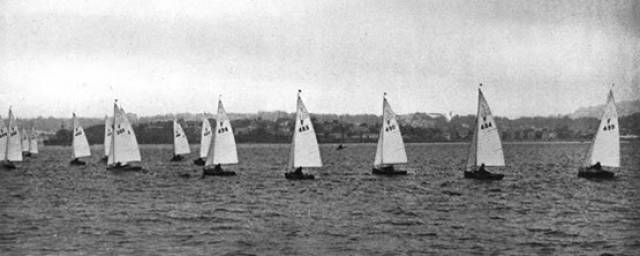
The dinghy synonmous with team racing in Ireland (and also early Olympic Games endeavours) celebrates an important birthday this year and the UK class is making a special effort to push the boat out. Designed in 1938 by Uffa Fox, as a one design boat suitable for team racing, the 2016 season marks the 70th Anniversary of Firefly Class; the first boats came off the production line at Fairey Marine, Hamble, in 1946. It was originally requested by Oxford and Cambridge Universities, requiring a dinghy similar to the National 12, but more suitable for team racing.
The design was completed in 1939 just prior to hostilities that would put back any ideas of production for more than six years. After the War, the Fairey Aviation Company had the idea of manufacturing a dinghy using the principles that constructed so many wooden Mosquito aircraft fuselages during the war, with diagonal laminates formed on a mould and cured by electrically heated bands holding the laminate in position.
SELECTED FOR THE 1948 OLYMPIC GAMES
As the 1948 Olympics in Britain approached, there were very few dinghies available in numbers, but the Firefly could be built quickly and in volume, so was selected as the single handed sailing dinghy for the Games.
Throughout the years, the class has been popular with many Schools and Universities, both in the UK and overseas, where it is sailed in team racing events. Many students have experienced their first dinghy racing in a fleet of Fireflies.
Some of the most famous names in sailing have previously raced Fireflies, including Paul Elvstrom, Bruce Banks, Richard Creagh Osborne and Jack Holt As well as current and six times World Match Racing champion Ian Williams.
NOW ONE OF THE MOST POPULAR BOATS
With more than 4250 boats built (650 built by Rondar Raceboats) the Firefly is one of the UK’s most popular and successful classes. It has now also been sold successfully overseas with fleets in the USA and Canada.
Many have preconceptions of what Firefly you would need to win the Nationals, but history has proven that the original wooden hulls and GRP hulls from every era all have a chance of winning; there are no inequalities in hull performance, unlike some classes. And you can sail at whatever level you choose – no maintenance or classic restored varnished hulls.
FLEET AND TEAM RACING
The Firefly is well respected as the ideal dinghy for team racing, offering good equal performance, great manoeuvrability and capable of being sailed in all weather conditions; it's always a team racing contender in the Endeavour Trophy, finishing 4th last year.
Team racing takes place at University Sailing Clubs, numerous schools and associations up and down the country each weekend.
During 2015, the ISAF World Team Racing Championships was held in the UK with many overseas teams participating. The final, held in a fleet of new boats supplied by Rondar, was won by a team from the USA!
The UK Class Association also organise a programme of fleet racing each year with Open events, Regattas and a National Championship.
The 2016 National Championships will be held at this year at Tenby, 6-12 August and we are hoping for 100 boats!
To celebrate this historic milestone the class and suppliers have come together to prize draw a brand new complete boat as a prize. It will require entrants to “beg, steal or borrow” a boat and compete in any of the nominated events or qualifying via club races this season, to secure a ticket in the prize draw for a brand new Rondar boat. The more race entries equals more prize draw chances. Conditions apply so please get details of how to enter from the UK Firefly website: www.fireflyclass.co.uk