
























Menu

Ireland's sailing, boating & maritime magazine

RBC Brewin Dolphin proudly supporting Afloat and Irish Boating

"Deathball" Sponge Among New Discoveries By Ocean Census Programme

5th November 2025
“A
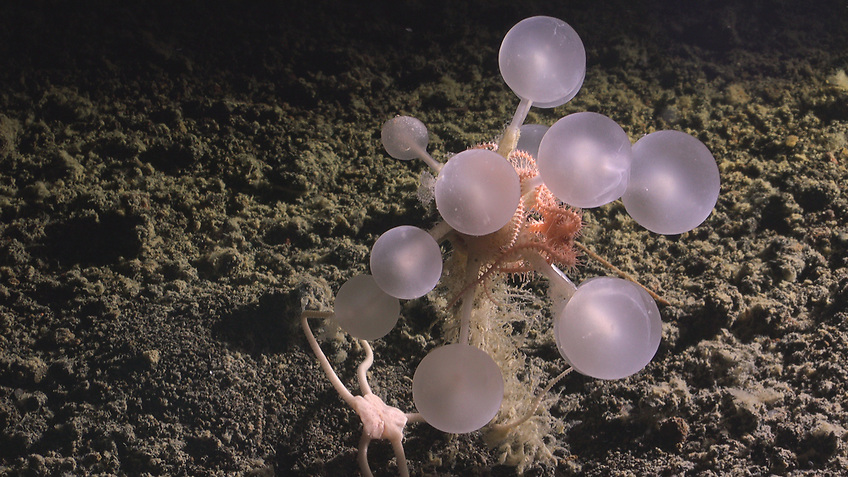
A carnivorous “death ball” sponge discovered off the South Sandwich islands by the Nippon Foundation-Nekton Ocean Census

Up to 30 previously unknown deep-sea species, including a carnivorous “death-ball” sponge, have been confirmed from one of the most remote parts of the planet.

The species were recorded by scientists involved in the Nippon Foundation-Nekton Ocean Census during two research cruises with the Schmidt Ocean Institute.

The new predatory sponge (Chondrocladia sp. nov.) is described as spherical and covered in tiny hooks that trap prey - a contrast to the gentle, passive, filter-feeding undertaken by most sponges.

“Zombie worms” (Osedax sp.) were also observed, the scientists say.

Although not thought to be new to science, these worms have no mouth or gut and rely on symbiotic bacteria to break down fats inside the bones of whales and other large vertebrates.

“Accelerating species discovery is not a scientific luxury, it is essential for public good,” Mitsuyuki Unno, Executive Director of The Nippon Foundation, who leads Ocean Census with the Nekton Foundation, said.

“Ocean Census is a program with the goal to reveal the unknowns of our world. Through its expeditions, we have seen another groundbreaking species discovery that benefits the world’s scientists, policymakers and communities.”

The search for new species in the South Sandwich islands involved an Ocean Census Flagship expedition onboard Schmidt Ocean Institute’s R/V Falkor.

The team used an ROV to survey volcanic calderas, the South Sandwich Trench, and seafloor habitats around Montagu and Saunders Islands.

The team collected nearly 2,000 specimens across 14 animal groups (phyla), alongside thousands of high-definition images and hours of video.

Highlights include new hydrothermal vents at ~700 m with chemosynthetic communities, vibrant coral gardens, evidence of explosive undersea volcanism, and the first confirmed footage of a juvenile colossal squid.

“The Southern Ocean remains profoundly under-sampled. To date, we have only assessed under 30% of the samples collected from this expedition, so confirming 30 new species already shows how much biodiversity is still undocumented,” Dr Michelle Taylor, Head of Science at The Nippon Foundation-Nekton Ocean Census, said.

The Nippon Foundation-Nekton Ocean Census is the world’s largest alliance dedicated to accelerating the discovery of ocean life.

Established by The Nippon Foundation, a Japanese philanthropic organisation, and Nekton in 2023, the Ocean Census brings together hundreds of scientists and institutions across the globe to explore, document, and share the diversity of marine species at unprecedented speed and scale.

The Schmidt Ocean Institute was established in 2009 by Eric and Wendy Schmidt.

Afloat.ie Team

About The Author

Afloat.ie Team

Email The Author

Afloat.ie is Ireland's dedicated marine journalism team.

Have you got a story for our reporters? Email us here.

We've got a favour to ask

More people are reading Afloat.ie than ever thanks to the power of the internet but we're in stormy seas because advertising revenues across the media are falling fast. Unlike many news sites, we haven't put up a paywall because we want to keep our marine journalism open.

Afloat.ie is Ireland's only full-time marine journalism team and it takes time, money and hard work to produce our content.

So you can see why we need to ask for your help.

If everyone chipped in, we can enhance our coverage and our future would be more secure. You can help us through a small donation. Thank you.

Direct Donation to Afloat button

Marine Wildlife Around Ireland One of the greatest memories of any day spent boating around the Irish coast is an encounter with marine wildlife.  It's a thrill for young and old to witness seabirds, seals, dolphins and whales right there in their own habitat. As boaters fortunate enough to have experienced it will testify even spotting a distant dorsal fin can be the highlight of any day afloat.  Was that a porpoise? Was it a whale? No matter how brief the glimpse it's a privilege to share the seas with Irish marine wildlife.

Thanks to the location of our beautiful little island, perched in the North Atlantic Ocean there appears to be no shortage of marine life to observe.

From whales to dolphins, seals, sharks and other ocean animals this page documents the most interesting accounts of marine wildlife around our shores. We're keen to receive your observations, your photos, links and youtube clips.

Boaters have a unique perspective and all those who go afloat, from inshore kayaking to offshore yacht racing that what they encounter can be of real value to specialist organisations such as the Irish Whale and Dolphin Group (IWDG) who compile a list of sightings and strandings. The IWDG knowledge base has increased over the past 21 years thanks in part at least to the observations of sailors, anglers, kayakers and boaters.

Thanks to the IWDG work we now know we share the seas with dozens of species who also call Ireland home. Here's the current list: Atlantic white-sided dolphin, beluga whale, blue whale, bottlenose dolphin, common dolphin, Cuvier's beaked whale, false killer whale, fin whale, Gervais' beaked whale, harbour porpoise, humpback whale, killer whale, minke whale, northern bottlenose whale, northern right whale, pilot whale, pygmy sperm whale, Risso's dolphin, sei whale, Sowerby's beaked whale, sperm whale, striped dolphin, True's beaked whale and white-beaked dolphin.

But as impressive as the species list is the IWDG believe there are still gaps in our knowledge. Next time you are out on the ocean waves keep a sharp look out!





















