



























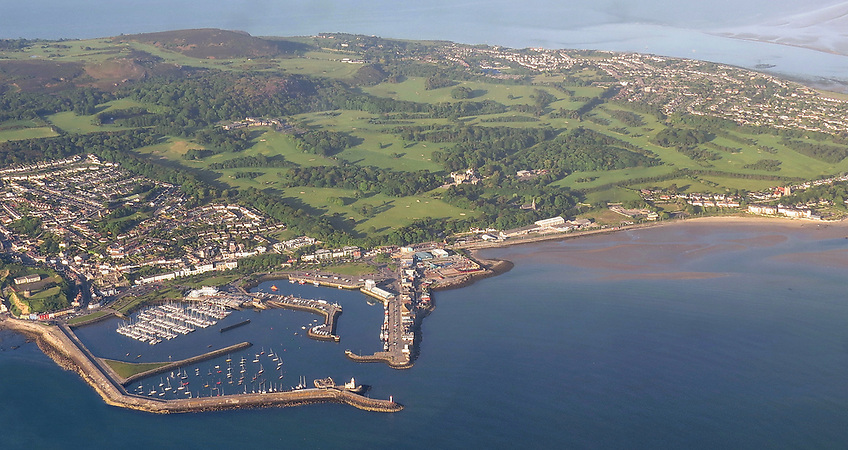
Time was when international arrogance and slow-changing prejudices allowed a statement like this: "The Irish and the Dutch should change places. Within a decade, Ireland would be the world's finest Market Garden, and The Netherlands would have disappeared."
It was reputedly Otto von Bismarck (1815-1898), unifier of Germany and its first Chancellor from 1871 to 1890, who first said it. He was the man who put the "real" into Realpolitik, and he coined that pithy summation at a time when Ireland was in some sort of turmoil, while the Dutch were literally fighting to keep their heads above water through massive public works that required unprecedented engineering skills combined with determined and continuous upkeep.
 The depths recorded in metres in Howth Harbour's most recent survey, much reduced from the re-opening of the harbour with its new layout in 1982.
LACK OF DREDGING MAINTENANCE
In Ireland, we produce some formidable, courageous and creative civil engineers. But it's only relatively recently that regular care of public property and infrastructure seems to be getting the priority that is essential, and in one area in particular we still seem to be lagging woefully on the matter of maintenance.
For though our smaller harbours seem well looked after to the point of being picturesque, it is literally only superficial. It is on the surface, above sea level at high water, that they look their best. But underneath, there's a continuous dumping ground in action as accumulating sea-carried sand and mud reduce the depths essential to a harbour's functioning.
 Drone photo evidence of boats on the swinging moorings in the Outer Harbour ploughing their own circles in the mud. Photo: Tomas Ryan
HOWTH CONCERN
The awareness of this problem in Howth has seen ongoing behind-the-scenes consultation with feasible schemes being developed. But the grounding this week of the Clogherhead fishing boat Ambitious II as she headed seawards from the Howth fish dock reportedly two hours after low water has resulted in significant publicity.
 The superbly-maintained Clogherhead trawler Ambitious II was aground this week while trying to exit the fish dock in Howth Harbour two hours after low water.
 In order to maximize volume within length limits, Ambitious II draws 3.4 metres forward…..….and 5.2 metres (17ft) aft
That said, Ambitious II's deepest draft is 3.4 metres forwards and an impressive 5.2 metres aft. But all of the fishing fleet regardless of size are concerned about the loss of depth, and it more directly affects the Howth Yacht Club fleet both in the Outer Harbour on swinging moorings, and in the Marina.
DUTCH EXAMPLE
Being firmly of the opinion that the Dutch are the world's leading maritime nation, I asked a Master Mariner familiar with its ports about their dredging programme, and the answer was that every port is dredged on a set rota at least once every five years, regardless of how non-urgent is the dredging requirement.
 The dredging of Howth Harbour may be a continuous challenge, but it is by no means an insuperable one.
When we remember that many of the Dutch ports are within a non-tidal system enclosed behind sea dykes, this fastidious attention to depth maintenance puts our own apparently lackadaisical "system" to shame. But the fact that tidal streams are almost always involved in our harbours exacerbates the problem.
"JUST-IN-TIME" BECOMES "FAR-TOO-LATE"
Of course our great commercial ports like Dublin and Cork have their own exemplary dredging systems, and they will also bring in outside contractors when necessary. But some of the in-between harbours have been relying on a supposedly just-in-time system which, when it is finally activated, proves actually to be a "far-too-late-altogether" approach.
 When they just took it as it was – Howth Harbour in the 1870s
I realise that we seem to have had a wave of stories about Howth sailing and its successes recently. But from being one of Ireland's smaller clubs, in half a Century it has blossomed into the numerically biggest, with sailing achievements to match. This is in no small measure due to the completely re-developed harbour, basically finished in 1982.
 HYC Commodore Kevin Monks with HYC International & Olympic star Eve McMahon
PROVISION OF DREDGED BASIN AGREED
From it, HYC emerged with the deal that a large dredged basin was created on the southeast side of the harbour provided that HYC filled it with a fully-equipped marina and built a new clubhouse beside it, thereby removing all recreational boating from the west side of the harbour to leave it clear for fishing activities.
With the hindsight of knowing what has happened since, it seems so utterly sensible that all this was done. Yet some people were understandable extremely nervous about a then-small club agreeing to such a massive undertaking, but generally it has worked very well.
However, what the comprehensive deal seems to have overlooked was a programme for the regular overall dredging of the harbour and marina. This requirement is an inevitability, for although the tide flooding northwestward through Howth Sound is relatively clear in its progess and lack of sand, the ebb running southeast is sand-laden, and one stream of it is re-directed into the harbour by the very necessary lighthouse-capped nib that provides essential shelter to the entrance in strong onshore winds.
NEW PLAN WOULD DEFLECT SAND-CARRYING EBB TIDE
If the proposed plan for further dredging is adhered to with the spoils being used to create a new space west of the harbour, the ebb tide will flow more directly past the outer end of the lighthouse nib.
 A Scottish Zulu-type fishing boat departs the harbour as Howth's first dredging scheme gets under way in the 1880s.
But at the moment the buildup of sand and mud in the harbour is an inevitability which from time to time requires dredging. Depths can be fairly easily maintained in the fisheries dock as it is clear when the fleet puts to sea, but the outer harbour on the east side has to remove swinging moorings, while dredging in the marina is a specialised skill.
Nevertheless it can be done, and it is done. Cowes Yachthaven in the Medina River in the Isle of Wight is a 260-berth marina similarly prone to tide-carried sediment, but last Autumn they got specialists to work on the dredging, and the job was done with full depths-plus restored in just two months.
The problem may be greater in Howth, as some areas of the harbour might be of interest to geologists, for what was originally soft sediment "appears to be well on the way to becoming sandstone rock". That is perhaps an exaggeration, but it shows the challenges of the problem.
WEAR AND TEAR
On top of that, it is now nearly 45 years since Howth Yacht Cub installed the heavy-duty vertical timber piles that hold the marina in place as it moves up and down with the tide, and inevitably many of them are now significantly worn. When major dredging work is being done with the harbour, the club wants to use the opportunity to replace those timber verticals with steel piles.
 A proposed dredging scheme could see new land being created west of the harbour
THE COMMODORE'S VIEW
HYC Commodore Kevin Monks told Afloat.ie this week that he and his specialist team have been in frequent consultation with the various authorities in urgently pressing for dredging, and it seems that at the moment the final part of the official agreement for work to proceed is authorisation from the Environmental Protection Agency.
Everything else is in place, and when the EPA go-ahead comes, HYC has whittled the necessary preparation time down to just six months before all is clear for the contractors to come on site.
 A place transformed. Howth Harbour as it might be if the proposed plans come to fruition, and the spoil from dredging is used for landfill west of the harbour, thereby deflecting the sand-carrying ebb tide from circulating within the harbour basin
Commodore Monks has no doubt about the importance of all this for HYC:
"At the moment the HYC marina/clubhouse complex is the largest employer in Howth. If we cannot get our access and berthing facilities up to international standard, we are going to find that newcomers to sailing are going to take themselves and their boats elsewhere, while established members and boats will also look at other options. We will also lose the hosting of major international events. If that happens, we are going to have to let go some of our most-valued and highly-trained staff. In that worst case, the current very positive setup and good atmosphere within the club may never be regained. The dredging is now a matter of urgency".