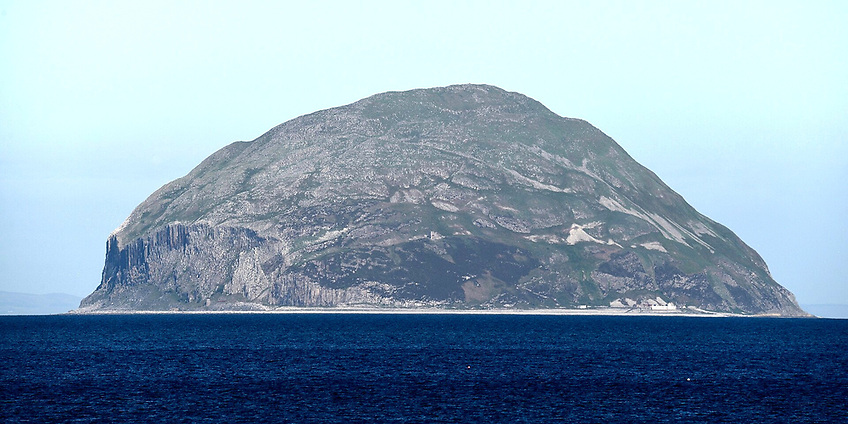
For most sailing people, the nearest our sport gets to the Olympically-trendy ice sport of curling is when we race round the distinctive granite plug of Ailsa Craig in the mouth of the Firth of Clyde. For it’s The Craig that provides the best granite to make the curling stones.
Yet one of the keenest early promoters and developers of curling was a Scottish sailing man, Dr John Cairnie (1769-1842). Glasgow-born, he’d served as a ship’s surgeon with the East India Company, and though he returned to Scotland a wealthy man, he’d paid hard for it, as he lost an arm when a barrel of gunpowder exploded.
VERY FULL RETIREMENT
Far from letting it limit his activities, if anything his disability spurred him on to a very full retirement. He settled in 1812 in Largs near Fairlie on the east shore of the Clyde in a house he called Curling Hall, and sailed in the summer and organised curling in a pond he created beside the house in winter.
 John Cairnie’s Fife cutter Nancy sailing off Curling Hall
But although he lived to see the beginning of the Victorian era in the late 1830s, John Cairnie was definitely pre-Victorian in his attitudes and equality of outlook. So much, in fact, so that when he and his personal servant found themselves incapably drunk of dressing the doctor properly when attending some function, he imposed a very gentle discipline by suggesting that in future, only one of them would take to the bottle on such occasions, but would take it in turns.
 By the time the Royal Northern YC staged this regatta on the Clyde in 1830, its Scottish branch was dominant, and the founding Belfast Lough branch was subsumed into it in 1838
FROM BELFAST LOUGH TO THE CLYDE
A clubbable man, he played a leading role in having the Northern Yacht Club – found in Belfast Lough in 1824 – establish what was theoretically a branch in the Clyde, and by 1830 it was the Royal Northern YC and almost totally based in the Clyde, where it was said of him:
“As fine a curler as he was a yachtsman, Dr. Cairnie was a typical all-the-year-round sportsman, with unlimited enthusiasm and no mean skill on the rink or on the sea. The dovetailing of his two great sports is of itself interesting. It was Dr. Cairnie who founded the Royal Caledonian Curling Club, and he also introduced the game into Ireland and invented the artificial curling pond.
 Dr John Cairnie demonstrating his skill at curling. In addition to the usual challenges, he had to maintain balance and power despite lacking his left arm. Photo: Facebook
Although so keen a curler, he could not have his yacht out of sight even in winter, and, to solve the problem, he had her drawn up on a cradle close by his curling rink, and as she sat there, he entertained his curling guests on board. The little boat would also carry the granite blocks from Ailsa Craig which were to be hewn into stones for the ‘Roarin’ Game.’
 In its early days in Scotland, some participants felt that a top hat was the appropriate headgear for curling.
LENGTHENING THE BOAT
About 1830 the success of Mr. Robert Sinclair’s Clarence brought about many alterations in the models of existing yachts, and, among others, Dr. Cairnie’s Nancy was lengthened. William Fife did the work, and, so that the doctor should not lose sight of his beloved little ship for so long a period, the alteration was carried out at Curling Hall. During the progress of the work the second William Fife, then a mite of a child, carried his father’s dinner over the three miles which separated the Nancy’s home from the yard at Fairlie.
In a work which Dr. Cairnie wrote on curling, the following passage occurs: ‘We have what we call picnic dinners, where every curler provides his own dish, and brings the drink he likes best. We, last season (1832), had four of these picnics aboard the yacht, and the scene of festivity was on board of our cutter, lying high and dry on her carriage by the seaside. The first dinner this season was on November 5, and called forth the thunder of our artillery when the toast appropriate to the day and those connected with curling were given from the chair.”
 Tough cookie. Despite losing an arm in a gunpowder explosion and putting his liver through some frequent and ferocious workouts, sailing/curling pioneer Dr John Cairnie lived actively to the age of 73.
The very idea of a yacht hauled out beside a curling pond in order to provide a warm and hospitable pavilion is a stroke of genius. And to make it complete and official, when the frost was sufficient to make the pond safe for sport, the signal was given by having the Royal Northern Yacht Club burgee hoisted aboard the Nancy.