





















Menu

Ireland's sailing, boating & maritime magazine

RBC Brewin Dolphin proudly supporting Afloat and Irish Boating

Big Turnout for Rambler 100 Team Racing Event at Baltimore Sailing Club

20th August 2018
 Winning Team Eoin Horgan (captain) with crew Jonjo Coleman, Richard Bushe (helm) with crew Richard Buckley Winning Team Eoin Horgan (captain) with crew Jonjo Coleman, Richard Bushe (helm) with crew Richard Buckley

The Annual Rambler 100 Team Racing Event was held on Sunday at Baltimore Sailing Club. This event encourages all young sailors to compete as helms or crew with a combined age of no more than 30 years. The competition sees two teams race - 2 boats versus 2 boats. Nearly 50 sailors signed up however, the early morning fog did nothing to dampen their spirits.

The trophy was very kindly donated by George David to commemorate the capsize and subsequent rescue of the Rambler 100 crew on August 15, 2011 off the Fastnet Rock. This was the 8th time the event had been contested and this year was just as competitive and exciting for all sailors and spectators.

Registration was held while everyone waited for the fog to lift. A race briefing was then held along with team announcements giving the sailors time to prepare their boats. Thankfully, the fog cleared and crews took to the race course in the harbour within sight of the pier. It was a hectic schedule of races - 30 races initially to complete the round robin before the semi finals and final races took place.
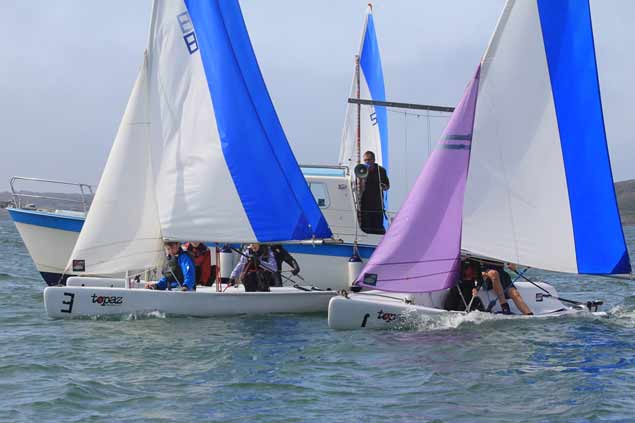
Rambler100 team racing topazThe Rambler100 team racing competition at Baltimore Sailing Club

There was a nail biting final (best of 3) with Eoin Horgan’s team winning two to secure their win but not before a broken mast delayed proceedings. After racing all sailors then headed for home to enjoy pizza and the prize giving in the Clubhouse. Commodore Niall O’Neill thanked everyone for their assistance in running the event with particular mention to Maria Coleman.

Third Place team - Keelin Greene (captain) with crew Emer O'Neill, Sarah O’Flynn (helm) with crew Jenya Kelly.

Second place team - Cillian Walsh (captain) with crew Jenny O”Brien, Katie O’Keeffe (helm) with crew Seamus Griffiths.

The winning team was Eoin Horgan (captain) with crew Jonjo Coleman, Richard Bushe (helm) with crew Richard Buckley.


Published in Team Racing
Afloat.ie Team

About The Author

Afloat.ie Team

Email The Author

Afloat.ie is Ireland's dedicated marine journalism team.

Have you got a story for our reporters? Email us here.

We've got a favour to ask

More people are reading Afloat.ie than ever thanks to the power of the internet but we're in stormy seas because advertising revenues across the media are falling fast. Unlike many news sites, we haven't put up a paywall because we want to keep our marine journalism open.

Afloat.ie is Ireland's only full-time marine journalism team and it takes time, money and hard work to produce our content.

So you can see why we need to ask for your help.

If everyone chipped in, we can enhance our coverage and our future would be more secure. You can help us through a small donation. Thank you.

Direct Donation to Afloat button

About Team Racing

Team racing in sailing is an exciting, strategy-focused format where two teams, usually with three boats each, compete to achieve the best combined score by the end of the race. Unlike fleet racing, where individual performance matters most, team racing emphasises teamwork, tactics, and boat positioning to outmanoeuvre the opposing team.

Each team typically has three boats, often two-person dinghies like the Firefly class. The boats from each team are distinguished by their unique sail colours or numbers.

Points are assigned to finishing positions, with 1 point for 1st place, 2 points for 2nd place, and so on. The team with the lowest combined score wins. The target is to achieve a "winning combination" of points. In a six-boat race (three per team), winning combinations include scores like 10 points or less for a 1-2-6 or a 2-3-5 finish.

Teams can slow down or block opposing boats, especially in an advantageous position. A boat ahead can "cover" an opponent, manoeuvring to block the wind and slow them down.

Teams often employ manoeuvres to help slower boats catch up or pass opponents, switching positions if needed. This keeps the team in a winning configuration.

At key turning points, boats can execute mark traps, where they intentionally slow down or position themselves to block opponents, forcing them into bad turns or causing them to lose speed.

Team racing follows standard sailing rules but with some additions tailored to team tactics. For example, a "fouling" boat (one that breaks a rule) must complete a penalty turn or even multiple turns, depending on the rule violation. Penalty management is crucial as it can make or break a team's success in the race.

Constant communication is key as team members coordinate strategies, adjust for wind shifts, and adapt to changes in the race. They signal intentions, warn of opponents' moves, and ensure every team member’s position is optimized.

In short, team racing combines fast-paced sailing with strategic teamwork. While speed is essential, winning often depends more on positioning, communication, and the ability to execute effective tactics as a team.