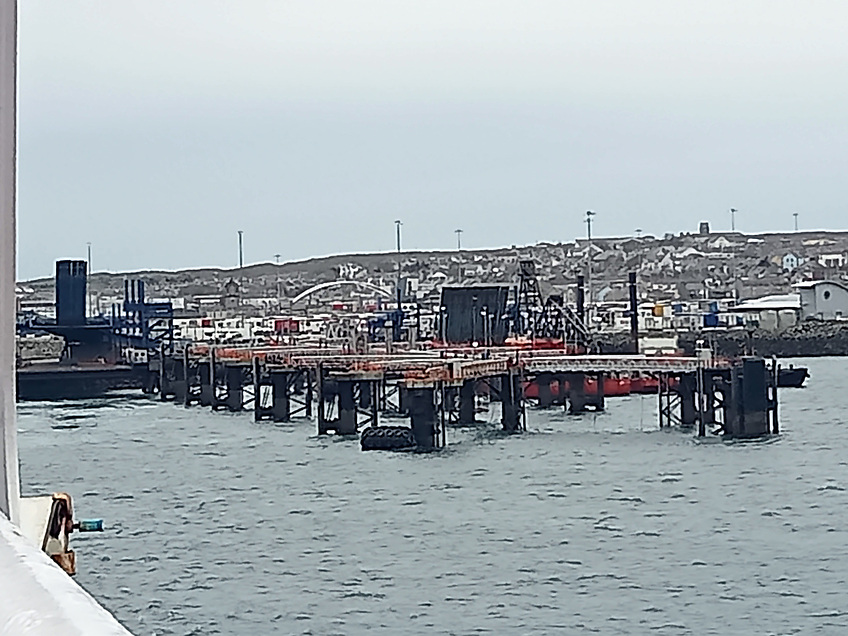
Following a berthing incident at Holyhead that caused damage to its ferry terminal on Friday, due to severe weather conditions at the North Wales port, one of the busiest in the UK, it remains, albeit partially, open, as BBC News reported here.
Afloat has since sought a comment from Stena Line Ports, which issued a statement on the recent incident. “Due to severe weather conditions on Friday, 05 December, a berthing incident occurred at Terminal 5. Current weather conditions prevent a full assessment of the berth structure; therefore, as a precautionary measure, we have temporarily closed Terminal 5 to ensure safety. The terminal will remain closed until all structures have been thoroughly inspected and cleared for normal operations. This assessment will take place when the weather conditions improve. We apologize for any inconvenience this may cause; however, the health and safety of our colleagues and customers remains our first priority. Holyhead Port continues to facilitate the full sailing schedule for ferry operators."
The port on Anglesey, which is operated by Stena Line, remains partially open, as it has two berths, and the port authority said it will remain temporarily closed to ensure safety but added the port "continues to facilitate the full sailing schedule for ferry operators."
The incident follows last year’s berthing incidents when two ferries made contact with the terminal, causing damage just before a red weather warning came into force and before the peak of Storm Darragh struck the port, initially leading to the temporary closure of the port. This caused major disruption in the run-up to the festive season and affected thousands of passengers and freight, forcing them to make alternative travel plans. This incident also led to temporary routes established to cope with congested traffic building up on Anglesey from where it was diverted to other ports and routes linking Ireland.
The damage was caused at the port’s outer harbour, at Salt Island’s exposed jetty, Terminal 3 (T3) used by Irish Ferries; however, during its repairs, they shared the adjacent Terminal 5 (T5). Repairs took place for seven months when the port finally became fully reopened in July, but the incident caused economic impact at Holyhead and on both sides of the Irish Sea, highlighting the vulnerability of the vital trade link between Ireland and the UK.
At a hearing held by the Welsh Parliament (Senedd Cymru), a committee in March, one of the participants, Liam Lacey, director of the Irish Maritime Development Office (IMDO), called the situation at Holyhead in December a "perfect storm" with businesses "ramping up before Christmas." He added other ports such as Liverpool being fully booked, and the "unusual" occurrence of both berths at Holyhead being damaged at the same time.
In addition, also that month, a joint task force was established between the Irish and Welsh governments to ‘strengthen’ the vital trade link; however, this latest incident had unfortunately affected yet more passengers, tourists, and freight shipments.