























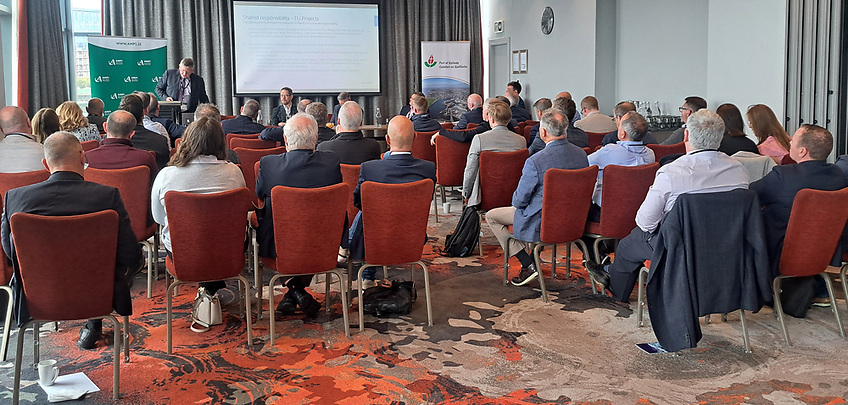
To secure Ireland's maritime future, there must be investment in both people and ports, the Chairman of the Association of Marine Pilots has told their annual conference in Limerick.
Patrick Galvin was addressing pilots from ports all around the coast, discussing 'The Value of Pilotage,' the theme of the meeting, as a critical service for Ireland’s prosperity.
"More than a technical or legal formality, pilotage is crucial to our economy, environment and infrastructure. Pilots ensure the safe and efficient movement of goods by ship, which is essential for our island nation. Up to 90% of imports and exports are transported by sea," he said, describing pilots as "a unique profession" and ports as "pivotal for the functioning of Ireland."
"One of our Association’s primary objectives is to introduce clear, minimum standards for entry, training and ongoing professional development for pilots across all Irish ports.
To make this a reality, we call on the government to comprehensively review how pilotage is managed and organised in every Irish port, and to formally adopt IMO A960 — the international standard for pilot training and certification. By implementing this international standard, not only will we elevate pilotage standards nationwide and strengthen safety for all parties involved, but we also enhance national security by reducing the risk of maritime accidents and potential pollution incidents. This adoption serves as a proactive measure to bolster Ireland’s climate resilience and ensures the continued efficiency of our vital supply chains.
"Ports are the backbone of Ireland’s economy and require sustained government support to meet both current and future demands of the maritime sector."
A clear trend concerning pilots is the increasing size of ships. Advancements in technology —such as improved emissions controls and fuel-saving systems - have made ships harder to manoeuvre.
"With ports remaining largely the same size, pilots must become increasingly technically skilled, while also maintaining and updating their traditional expertise. Technology will continue to shape how we work as pilots. However, these systems have limitations, such as the risk of technical failure or interference with GNSS signals.
"This demonstrates that no tool can replace the expertise of a skilled, well-trained pilot on
the bridge. Human judgement and adaptability provide the resilience needed to keep our ports safe and operational, regardless of technological advances.
"To secure Ireland’s maritime future, we must invest in both people and ports. By upholding rigorous training, embracing technology responsibly and ensuring pilot expertise, we maintain safety and efficiency while adapting to larger ships."
With government and stakeholder support, Ireland’s ports will remain resilient, competitive, and prepared for global change, he said.