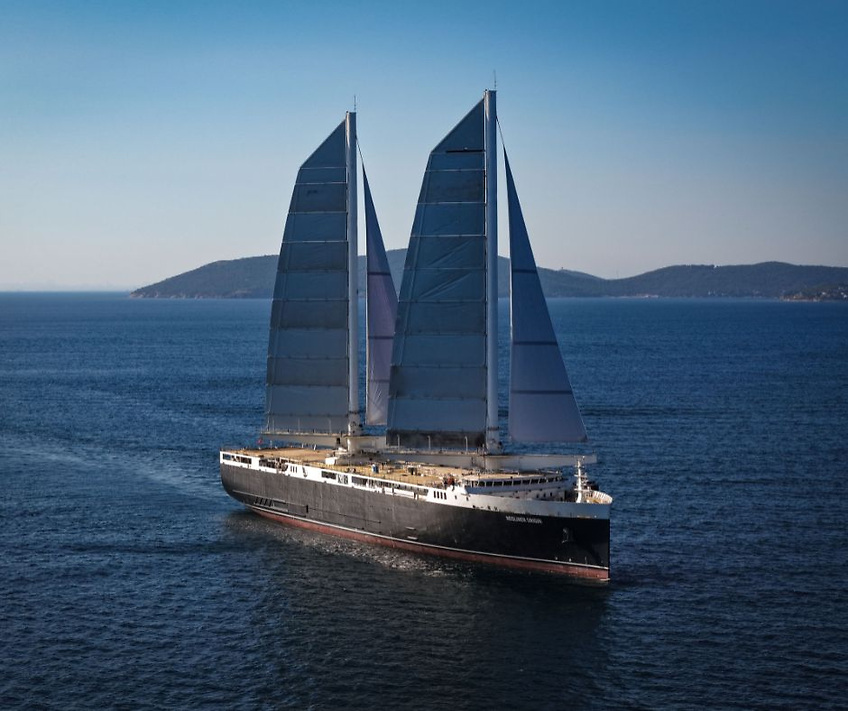
A newbuild sail ro-ro cargo ship, which was recently handed over to French wind-powered transport company Neoline, has completed its inaugural trans-Atlantic voyage in efforts to reduce harmful greenhouse gas emissions.
As Baird Maritime reported, the Neoliner Origin on Friday, 24 October, made its first port of call to Saint Pierre and Miquelon. Afloat adds that it is a self-governing overseas territorial collectivity of France, located near the Canadian province of Newfoundland and Labrador. In addition, the new sail cargo ship operates a regular route calling to Halifax and Baltimore, in neighbouring USA.
The cargo ship is registered at its owner's homeport of Nantes, Pays de Loire, and called nearby at Saint-Nazaire, Loire-Atlantique, from where the sail cargo ship departed eight days prior with a full cargo loaded onboard.
 Sail-cargo: After lowering its two sail masts to pass under the Saint-Nazaire bridge, Neoliner Origin called at Montoir-de-Bretagne to load part of the cargo for the pioneering French shipping company's newbuild bound for Saint-Pierre & Miquelon (a self-governing overseas territorial collectivity of France) bordering Canada. Some of this cargo was also unloaded in Baltimore, USA. Photo: Claire Ronsin & Nicolas Pougnand / Neoline-LinkedIn
Before its maiden commercial voyage, Neoliner Origin had lowered its masts to pass under the Saint-Nazaire bridge and called at Montoir-de-Bretagne (Saint-Nazaire), also in the Loire-Atlantique, to load a part cargo for its pioneering shipper customers.
Neoline said the ship sustained damage to an aft main sail mast during the crossing, though the foresail remained operational up to its arrival in Canada. The stern-only loading ship has since offloaded its cargo while technicians went on board to assist with repairs. Its next stop was in Baltimore, USA.
Neoliner Origin was designed by French naval architecture firm Mauric and built by RMK Marine Shipyard of Turkey. The 136m length overall (LOA) newbuild has a beam of 24.2 m and space for 1,130 lane m of freight across two garage decks, with space for 265 Twenty Equivalent Unit (TEU) containers.
Two 1,500-sq-m sails by Chantiers de l'Atlantique will enable the ship to reach speeds of up to 16 knots, and Mauric said trans-Atlantic voyages at 11 knots are possible on the sails alone. The sails are made up of rectangular composite panels assembled together and are mounted on 76 m masts that can be folded to enable safe passage underneath bridges.
Afloat also adds that there is a crew of 20 and passengers for 12, with accommodation comprising a lounge, sun deck, gym, dining area, and 6 two-berth cabins. The new sail ro-ro cargoship is currently making its first eastbound voyage from America and is expected to return to Europe on 13 November by returning to Montoir-de-Bretagne (St. Nazaire).
The port in western France may be familiar to ferry aficionados, as Afloat reported in 2014 that another French ferry company, LD Lines, launched the first-ever ferry service linking Ireland, France, and Spain. The passenger and freight service connecting Rosslare in Wexford with an en-route call to France and Gijón in Asturias involved passages on the Celtic Sea and Bay of Biscay routes.
The new Ireland-Iberian route formed part of a major extension of LD Lines' "Motorway of the Seas" Atlantic network with UK-France/Spain routes. However, the company closed the three-nation connecting service in the same year, having run for just over a mere 9 months.
Another French ferry operator but based in the Mediterranean, Corsica Ferries in 2023 had invested a stake in Neoline Armateur to build the 'Neoliner' powered mainly by wind, saving 80% of fuel compared to a conventional ro-ro ship.