



















Menu

Ireland's sailing, boating & maritime magazine

RBC Brewin Dolphin proudly supporting Afloat and Irish Boating

Tributes to the Late Dorothy Tyrrell Of Arklow's Shipbuilding and Lifeboat Family

25th November 2025
“(from
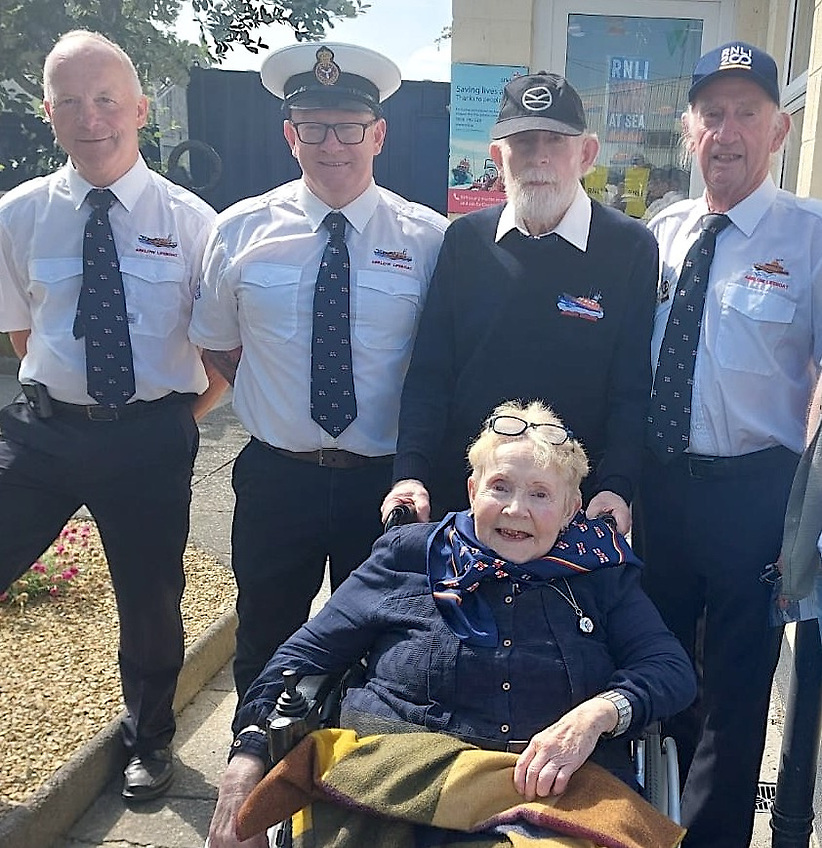
(from left to right) John Tyrrell, Arklow lifeboat deputy launching authority, John Tyrrell, assistant mechanic, John Tyrrell, former second coxswain and Jimmy Tyrrell, former lifeboat operations manager and RNLI life governor, with Dorothy Tyrrell at the recent naming ceremony for the RNLI Shannon-class lifeboat Roy Holloway at Arklow station.

Tributes have been paid to Dorothy Tyrrell of the Arklow Tyrrell shipbuilding family, who died peacefully last week in Co Wexford.

Dorothy, whose late father naval architect Jack Tyrrell designed and built the former sail training ship Asgard II, was known in both Caherdaniel, Co Kerry, where she lived for over 30 years, and in Arklow where her family are closely involved in the RNLI lifeboat.

She had “a heart that would drive a Jumbo jet”, her brother Jimmy Tyrrell said at her funeral.

“No man would have survived what she did,”he said, recalling his sister’s many medical operations, and paying tribute to her first cousins in Ferrybank who were “her heart and soul”.

Her cousin and god-daughter Pat Tyrrell, who also spoke at her funeral in Templerainey, Arklow, said that she “lived a long and a happy life” in spite of very many hospitalisations.

“While she would never in a million years have allowed disability to define her, she did have a very serious roller skating accident when she was about six,” Pat said.

“Then followed years of orthopaedic interventions and corrective surgery, much of which was unsuccessful – all of which resulted in Dorothy spending at least four years of her childhood/early adolescence in Cappagh Hospital,” she said.

“It is hard to contemplate now the impact of this early separation from her family and community, the fear and the pain, the loneliness and the difficult reintegration into home life on discharge,”Pat said.

She had endured the “inevitable teasing and taunting …from some children at school as she learned to walk again with sticks,” she said.

Dorothy Tyrrell with her cousin and god-daughter Pat and the late RTÉ journalist Charlie Bird at an open day in Shelton prison, Arklow, Wicklow.Dorothy Tyrrell with her cousin and god-daugher Pat and the late RTÉ journalist Charlie Bird at an open day in Shelton prison, Arklow, Wicklow.

“All of which makes Dorothy an even more remarkable woman in the endless love that she had for life, the delight that she got from people and places, and the fun and humour that she took into every situation and interaction,” Pat said.

“After school, she trained as a beautician in Dublin – we, as children, used to marvel at the glamour and style of our cousin when she visited us in Glenthorne. She seemed so beautiful and sophisticated,” she recalled.

“Then she trained as a secretary. Patty, her friend, tells a story of one of Dorothy’s teachers looking out the window of the secretarial college when Dorothy should have been in class to see her being piggy-backed up Grafton Street by some strong and handsome man. Why is this not hard to believe?” she said.

“Where others in her situation may have opted for a disability pension, Dorothy worked for many years as a secretary in Leopardstown Hospital. Living in flats in Dublin 4, there are many stories of these times that are perhaps better saved for another day,” Pat continued.

She recalled how after her parents Jack and Aileen died in 1988, Dorothy moved to Caherdaniel Co Kerry in 1990, and it was there that she met Ted Butler and spent over 30 of the happiest years of her life.

“ Her family links with all things nautical, her immense pride in the achievements of her grandfather and her father meant that Dorothy always had a huge love of the sea,”Pat said.

“In Caherdaniel, her house [designed by architect Kevin Murphy] was in the most idyllic spot,”she said.

“The changing skies, the wild seas, the wind and light working off each other – all served to inspire in Dorothy an ever growing creativity,”she recalled.

“She painted in watercolours and acrylics and oils, she painted on silk, she made cards with pressed flowers and bog cotton, she captured images on her camera and she made stained glass and ceramics,”Pat said.

“ And, among all of this, she found time to play bridge, deliver meals on wheels and socialise…”

“She made friends across the whole community. Anyone reading the tributes to Dorothy on RIP.ie will see how much she was loved in the Kingdom,”she said.

In 2020 Dorothy moved closer to her extended family to gain additional support, settling in Middletown Village near Courtown, Co Wexford.

“While the scenery and the wildness of the Iveragh Peninsula cannot be replicated, here she did find new friendships and community and she adapted to the changes in her usual positive way,” Pat said.

Pat described how she and her sisters Claire and Sheila had “endless fun with her during these last years”.

Pat expressed the hope that two of the latest arrivals into the Tyrrell family - Oona, Jimmy’s granddaughter, and Orla, Pat’s granddaughter - “have both been imbued with Dorothy’s spirit of feistiness and fun and friendship”.

The Late Dorothy TyrrellThe Late Dorothy Tyrrell

Dorothy, who was extremely proud of her family’s maritime connections, had attended the naming ceremony of Arklow RNLI’s €3.1m new all–weather Shannon class lifeboat last June with members of her family. Among the many expressions of sympathy on rip.ie is one from Arklow RNLI.

Dorothy Tyrrell is survived by her brothers Jimmy and John and extended family, and was pre-deceased by her brother Michael.


Afloat.ie Team

About The Author

Afloat.ie Team

Email The Author

Afloat.ie is Ireland's dedicated marine journalism team.

Have you got a story for our reporters? Email us here.

We've got a favour to ask

More people are reading Afloat.ie than ever thanks to the power of the internet but we're in stormy seas because advertising revenues across the media are falling fast. Unlike many news sites, we haven't put up a paywall because we want to keep our marine journalism open.

Afloat.ie is Ireland's only full-time marine journalism team and it takes time, money and hard work to produce our content.

So you can see why we need to ask for your help.

If everyone chipped in, we can enhance our coverage and our future would be more secure. You can help us through a small donation. Thank you.

Direct Donation to Afloat button

Royal National Lifeboat Institute (RNLI) in Ireland Information

The Royal National Lifeboat Institution (RNLI) is a charity to save lives at sea in the waters of UK and Ireland. Funded principally by legacies and donations, the RNLI operates a fleet of lifeboats, crewed by volunteers, based at a range of coastal and inland waters stations. Working closely with UK and Ireland Coastguards, RNLI crews are available to launch at short notice to assist people and vessels in difficulties.

RNLI was founded in 1824 and is based in Poole, Dorset. The organisation raised €210m in funds in 2019, spending €200m on lifesaving activities and water safety education. RNLI also provides a beach lifeguard service in the UK and has recently developed an International drowning prevention strategy, partnering with other organisations and governments to make drowning prevention a global priority.

Irish Lifeboat Stations

There are 46 lifeboat stations on the island of Ireland, with an operational base in Swords, Co Dublin. Irish RNLI crews are tasked through a paging system instigated by the Irish Coast Guard which can task a range of rescue resources depending on the nature of the emergency.

Famous Irish Lifeboat Rescues

Irish Lifeboats have participated in many rescues, perhaps the most famous of which was the rescue of the crew of the Daunt Rock lightship off Cork Harbour by the Ballycotton lifeboat in 1936. Spending almost 50 hours at sea, the lifeboat stood by the drifting lightship until the proximity to the Daunt Rock forced the coxswain to get alongside and successfully rescue the lightship's crew.

32 Irish lifeboat crew have been lost in rescue missions, including the 15 crew of the Kingstown (now Dun Laoghaire) lifeboat which capsized while attempting to rescue the crew of the SS Palme on Christmas Eve 1895.

FAQs

While the number of callouts to lifeboat stations varies from year to year, Howth Lifeboat station has aggregated more 'shouts' in recent years than other stations, averaging just over 60 a year.

Stations with an offshore lifeboat have a full-time mechanic, while some have a full-time coxswain. However, most lifeboat crews are volunteers.

There are 46 lifeboat stations on the island of Ireland

32 Irish lifeboat crew have been lost in rescue missions, including the 15 crew of the Kingstown (now Dun Laoghaire) lifeboat which capsized while attempting to rescue the crew of the SS Palme on Christmas Eve 1895

In 2019, 8,941 lifeboat launches saved 342 lives across the RNLI fleet.

The Irish fleet is a mixture of inshore and all-weather (offshore) craft. The offshore lifeboats, which range from 17m to 12m in length are either moored afloat, launched down a slipway or are towed into the sea on a trailer and launched. The inshore boats are either rigid or non-rigid inflatables.

The Irish Coast Guard in the Republic of Ireland or the UK Coastguard in Northern Ireland task lifeboats when an emergency call is received, through any of the recognised systems. These include 999/112 phone calls, Mayday/PanPan calls on VHF, a signal from an emergency position indicating radio beacon (EPIRB) or distress signals.

The Irish Coast Guard is the government agency responsible for the response to, and co-ordination of, maritime accidents which require search and rescue operations. To carry out their task the Coast Guard calls on their own resources – Coast Guard units manned by volunteers and contracted helicopters, as well as "declared resources" - RNLI lifeboats and crews. While lifeboats conduct the operation, the coordination is provided by the Coast Guard.

A lifeboat coxswain (pronounced cox'n) is the skipper or master of the lifeboat.

RNLI Lifeboat crews are required to follow a particular development plan that covers a pre-agreed range of skills necessary to complete particular tasks. These skills and tasks form part of the competence-based training that is delivered both locally and at the RNLI's Lifeboat College in Poole, Dorset


While the RNLI is dependent on donations and legacies for funding, they also need volunteer crew and fund-raisers.

© Afloat 2020