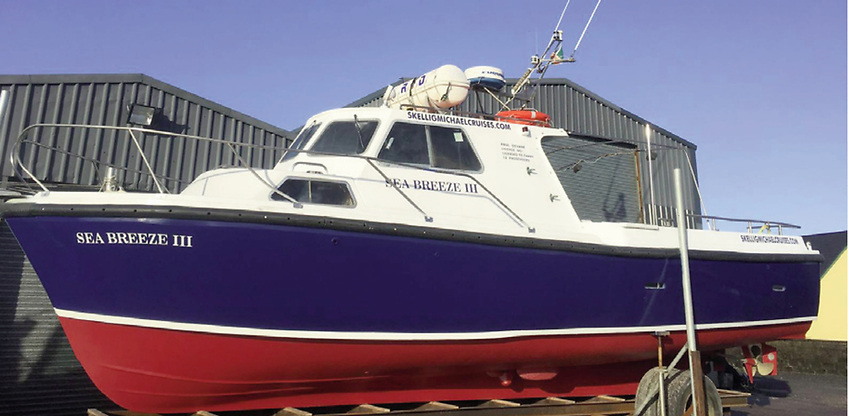
A group of 14 visitors to Skellig Michael and their boat skipper had a narrow escape last year when their vessel developed issues and sank after they were left on the rock.
A report by the Marine Casualty Investigation Board (MCIB) says that “if the emergency situation had developed during this passage, the outcome had the potential for far more serious consequences”.
The report into the sinking of the MV Sea Breeze III on July 7th, 2024, almost three nautical miles to the north of Little Skellig island, says it is not possible to provide a “definitive cause” as to why the hull began taking in water.
The skipper was rescued by another vessel “minutes prior to the sinking”, and the report notes that there was no call to the Irish Coast Guard by VHF radio or mobile telephone.
The Emergency Position Indicating Radio Beacon (EPIRB) was activated at 09.38 hrs as the vessel sank.
Another vessel was provided to bring the visitors back to the Kerry mainland after their visit to Skellig Michael.
“Based on the available evidence, a failure of a skin fitting or associated hose is the most probable cause of the water ingress, the report says.
It cannot rule out the possibility of an impact with the landing dock, “ given that the bilge alarm was activated within minutes of the vessel departing from the landing dock”.
It says that installation of a solar powered closed-circuit television system to monitor the landing dock on Great Skellig should be considered by the Minister of State for the Office of Public Works (OPW).
It says the camera “should have a publicly accessible live feed so sea conditions can be reviewed in advance of any approach to the landing dock and vessel movements recorded”.
It recommends that the Minister for Transport should also consider legislation requiring the electronic submission of passenger and crew lists by sightseeing vessel operators to the Irish Coast Guard, prior to departure on offshore voyages.
The report says vessel specific pre-departure checklists should be developed, with training in their correct use provided to all skippers and crew.
It says that refresher training should be given in the correct use of VHF radio in an emergency, and independent and detailed surveys of all connected vessels should be arranged.
The full report is here