
























Menu

Ireland's sailing, boating & maritime magazine

RBC Brewin Dolphin proudly supporting Afloat and Irish Boating

https://www.dublinport.ie/behind-the-scenes-tours-are-open/=

Dublin-Holyhead Ferry Route Identified as Green Shipping Corridor

18th September 2025
“The
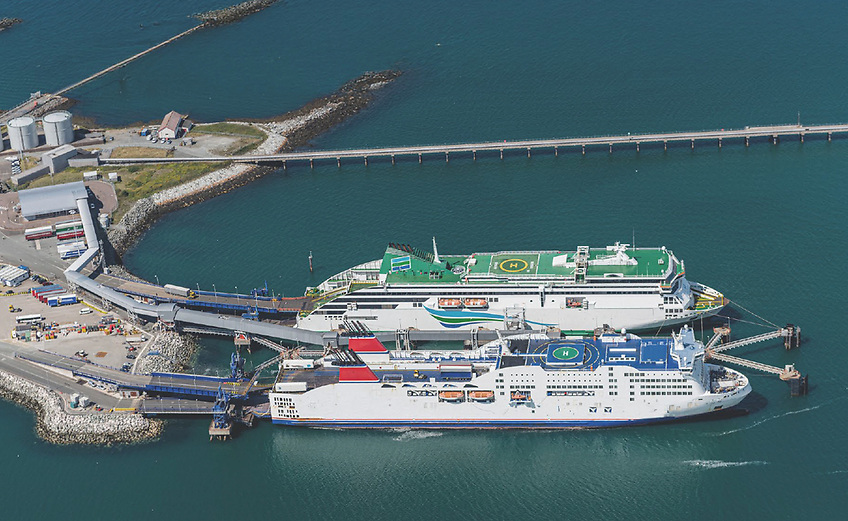
The feasibility study has recognised the busy Dublin-Holyhead trade and passenger route as a strong candidate for a green corridor trial

The ferry route between Dublin Port and the Port of Holyhead could serve as one of Europe’s first dedicated green shipping corridors, according to a new study. The study also identified green methanol as a suitable candidate fuel for the corridor with the potential to reduce greenhouse gas emissions by up to 80%.

The ‘Greening the Irish Sea – The Central Corridor’ study was led by Ricardo, a global environmental consultancy firm, working in partnership with ferry operators, Irish Ferries and Stena Line, as well as Dublin Port, the Port of Holyhead, and additional support from EDF UK R&D and Maynooth University. The report explored the feasibility of establishing a low-emission shipping route, a “green corridor”, between Holyhead and Dublin.

Methanol was found to be the most practical alternative fuel for this route, offering the possibility of retrofitting existing vessels and benefitting from established bunkering and handling experiences compared with other emerging fuels. While additional safety measures are required, methanol presents fewer operational challenges compared to ammonia or hydrogen. Battery-electric solutions were also explored but deemed infeasible due to the high energy demand, vessel size and operational flexibility needed on this route.

The Holyhead-Dublin trade route is the busiest roll-on/roll-off route between the UK and Ireland. In 2024, nearly 1.6 million people travelled this route, with over 6,000 sailings accounting for more than 70% of all ferry passenger movements between the two countries. The ports of Dublin and Holyhead serve as key economic gateways, with Dublin Port alone handling almost 80% of Ireland’s unitised freight. This study aims to advance the decarbonisation of this critical trade artery. This study aims to advance the decarbonisation of this critical trade artery.

On completion of the study, Matthew Moss, Ricardo’s Maritime Sustainable Transport Principal Consultant Research, said: “This study shows that the Holyhead–Dublin corridor offers strong potential as an early green shipping route in Europe. The combination of high traffic volumes and vessel suitability means it is a realistic location to trial alternative fuels at scale. While additional infrastructure investment will be required, methanol offers a pathway that can be enabled in the near term through vessel retrofits and established handling practices. To build on this work, clear policy signals and government support will be essential in creating the conditions for investment and deployment, helping accelerate the wider decarbonisation of the maritime sector.”

Johan Edelman, Stena Line’s Irish Sea South Trade Director, added: “It is incredibly encouraging to see the results of this feasibility study highlight Dublin-Holyhead as a potential green corridor. Sustainability is a strategic priority for Stena Line and as part of our long-term vision for a greener future, we commissioned two new freight ships for the Irish sea – both equipped to operate on methanol fuel. These ships have been purpose-built for the Belfast – Heysham route with the first is due to enter service on 22 September. We welcome government support to allow us to continue to offer cleaner more efficient transport solutions across our Irish Sea network.”

Irish Ferries Managing Director, Andrew Sheen, said: “We see a clear pathway toward operating a green corridor, but significant infrastructure development is needed across the supply chain to make alternative fuels cost-competitive with conventional options. We strongly urge our governments to reinvest the substantial revenues generated through carbon taxes into research, development, and the scaling of alternative fuels and their supporting infrastructure.”

Speaking about the project, Ken Rooney, Head of Engineering & Sustainability, Dublin Port Company, said: “We welcome this initial report and are looking forward to taking this to the next stage. One of the major challenges for critical infrastructure providers such as Dublin Port is the emergence of multiple possible alternative fuel options. Focusing on green methanol as one of these options gives us and the project partners a clear, realistic potential option to reducing emissions on this critical sea route. This presents an opportunity to have a material impact on marine emissions in the Irish Sea and gives us a better understanding of the needs of the sector, particularly in relation to energy supply. We are ready to work with our partners and customers to build upon the work of this initial study.”

Dr Patrick Rigot-Müller, Lecturer in Operations and Supply Chain at Maynooth University, one of the partners in the feasibility study, said: “Dublin-Holyhead is one of the main northern European ferry corridors in terms of potential for CO2 reduction. It is well-suited to serve as a demonstration project for Green Shipping Corridors in Europe. We are delighted to contribute to the understanding of green corridors for this busy route.”

Rebecca Rosling, EDF’s Head of Future Energy Systems R&D, said: “The energy transition demands action across all sectors, and maritime transport remains one of the most challenging and carbon-intensive. At EDF UK R&D, we are proud to have contributed our technical expertise to the Holyhead–Dublin Green Corridor initiative. This project exemplifies how targeted innovation - such as the adoption of e-fuels like e-methanol, produced using low-carbon electricity - can accelerate decarbonisation in high-impact areas. At EDF R&D UK our mission is to help build a brighter energy future for the UK, and we see green corridors like this as a vital step toward a sustainable, low-carbon society.”


Afloat.ie Team

About The Author

Afloat.ie Team

Email The Author

Afloat.ie is Ireland's dedicated marine journalism team.

Have you got a story for our reporters? Email us here.

We've got a favour to ask

More people are reading Afloat.ie than ever thanks to the power of the internet but we're in stormy seas because advertising revenues across the media are falling fast. Unlike many news sites, we haven't put up a paywall because we want to keep our marine journalism open.

Afloat.ie is Ireland's only full-time marine journalism team and it takes time, money and hard work to produce our content.

So you can see why we need to ask for your help.

If everyone chipped in, we can enhance our coverage and our future would be more secure. You can help us through a small donation. Thank you.

Direct Donation to Afloat button

About Dublin Port 

Dublin Port is Ireland’s largest and busiest port with approximately 17,000 vessel movements per year. As well as being the country’s largest port, Dublin Port has the highest rate of growth and, in the seven years to 2019, total cargo volumes grew by 36.1%.

The vision of Dublin Port Company is to have the required capacity to service the needs of its customers and the wider economy safely, efficiently and sustainably. Dublin Port will integrate with the City by enhancing the natural and built environments. The Port is being developed in line with Masterplan 2040.

Dublin Port Company is currently investing about €277 million on its Alexandra Basin Redevelopment (ABR), which is due to be complete by 2021. The redevelopment will improve the port's capacity for large ships by deepening and lengthening 3km of its 7km of berths. The ABR is part of a €1bn capital programme up to 2028, which will also include initial work on the Dublin Port’s MP2 Project - a major capital development project proposal for works within the existing port lands in the northeastern part of the port.

Dublin Port has also recently secured planning approval for the development of the next phase of its inland port near Dublin Airport. The latest stage of the inland port will include a site with the capacity to store more than 2,000 shipping containers and infrastructures such as an ESB substation, an office building and gantry crane.

Dublin Port Company recently submitted a planning application for a €320 million project that aims to provide significant additional capacity at the facility within the port in order to cope with increases in trade up to 2040. The scheme will see a new roll-on/roll-off jetty built to handle ferries of up to 240 metres in length, as well as the redevelopment of an oil berth into a deep-water container berth.

Dublin Port FAQ

Dublin was little more than a monastic settlement until the Norse invasion in the 8th and 9th centuries when they selected the Liffey Estuary as their point of entry to the country as it provided relatively easy access to the central plains of Ireland. Trading with England and Europe followed which required port facilities, so the development of Dublin Port is inextricably linked to the development of Dublin City, so it is fair to say the origins of the Port go back over one thousand years. As a result, the modern organisation Dublin Port has a long and remarkable history, dating back over 300 years from 1707.

The original Port of Dublin was situated upriver, a few miles from its current location near the modern Civic Offices at Wood Quay and close to Christchurch Cathedral. The Port remained close to that area until the new Custom House opened in the 1790s. In medieval times Dublin shipped cattle hides to Britain and the continent, and the returning ships carried wine, pottery and other goods.

510 acres. The modern Dublin Port is located either side of the River Liffey, out to its mouth. On the north side of the river, the central part (205 hectares or 510 acres) of the Port lies at the end of East Wall and North Wall, from Alexandra Quay.

Dublin Port Company is a State-owned commercial company responsible for operating and developing Dublin Port.

Dublin Port Company is a self-financing, and profitable private limited company wholly-owned by the State, whose business is to manage Dublin Port, Ireland's premier Port. Established as a corporate entity in 1997, Dublin Port Company is responsible for the management, control, operation and development of the Port.

Captain William Bligh (of Mutiny of the Bounty fame) was a visitor to Dublin in 1800, and his visit to the capital had a lasting effect on the Port. Bligh's study of the currents in Dublin Bay provided the basis for the construction of the North Wall. This undertaking led to the growth of Bull Island to its present size.

Yes. Dublin Port is the largest freight and passenger port in Ireland. It handles almost 50% of all trade in the Republic of Ireland.

All cargo handling activities being carried out by private sector companies operating in intensely competitive markets within the Port. Dublin Port Company provides world-class facilities, services, accommodation and lands in the harbour for ships, goods and passengers.

Eamonn O'Reilly is the Dublin Port Chief Executive.

Capt. Michael McKenna is the Dublin Port Harbour Master

In 2019, 1,949,229 people came through the Port.

In 2019, there were 158 cruise liner visits.

In 2019, 9.4 million gross tonnes of exports were handled by Dublin Port.

In 2019, there were 7,898 ship arrivals.

In 2019, there was a gross tonnage of 38.1 million.

In 2019, there were 559,506 tourist vehicles.

There were 98,897 lorries in 2019

Boats can navigate the River Liffey into Dublin by using the navigational guidelines. Find the guidelines on this page here.

VHF channel 12. Commercial vessels using Dublin Port or Dun Laoghaire Port typically have a qualified pilot or certified master with proven local knowledge on board. They "listen out" on VHF channel 12 when in Dublin Port's jurisdiction.

A Dublin Bay webcam showing the south of the Bay at Dun Laoghaire and a distant view of Dublin Port Shipping is here
Dublin Port is creating a distributed museum on its lands in Dublin City.
 A Liffey Tolka Project cycle and pedestrian way is the key to link the elements of this distributed museum together.  The distributed museum starts at the Diving Bell and, over the course of 6.3km, will give Dubliners a real sense of the City, the Port and the Bay.  For visitors, it will be a unique eye-opening stroll and vista through and alongside one of Europe’s busiest ports:  Diving Bell along Sir John Rogerson’s Quay over the Samuel Beckett Bridge, past the Scherzer Bridge and down the North Wall Quay campshire to Berth 18 - 1.2 km.   Liffey Tolka Project - Tree-lined pedestrian and cycle route between the River Liffey and the Tolka Estuary - 1.4 km with a 300-metre spur along Alexandra Road to The Pumphouse (to be completed by Q1 2021) and another 200 metres to The Flour Mill.   Tolka Estuary Greenway - Construction of Phase 1 (1.9 km) starts in December 2020 and will be completed by Spring 2022.  Phase 2 (1.3 km) will be delivered within the following five years.  The Pumphouse is a heritage zone being created as part of the Alexandra Basin Redevelopment Project.  The first phase of 1.6 acres will be completed in early 2021 and will include historical port equipment and buildings and a large open space for exhibitions and performances.  It will be expanded in a subsequent phase to incorporate the Victorian Graving Dock No. 1 which will be excavated and revealed. 
 The largest component of the distributed museum will be The Flour Mill.  This involves the redevelopment of the former Odlums Flour Mill on Alexandra Road based on a masterplan completed by Grafton Architects to provide a mix of port operational uses, a National Maritime Archive, two 300 seat performance venues, working and studio spaces for artists and exhibition spaces.   The Flour Mill will be developed in stages over the remaining twenty years of Masterplan 2040 alongside major port infrastructure projects.

Source: Dublin Port Company ©Afloat 2020.




















