
























Menu

Ireland's sailing, boating & maritime magazine

RBC Brewin Dolphin proudly supporting Afloat and Irish Boating

Oldest Car Ferry Built in Ireland Calls to Wicklow Port While On Coastal Passage to Lough Foyle

22nd March 2022
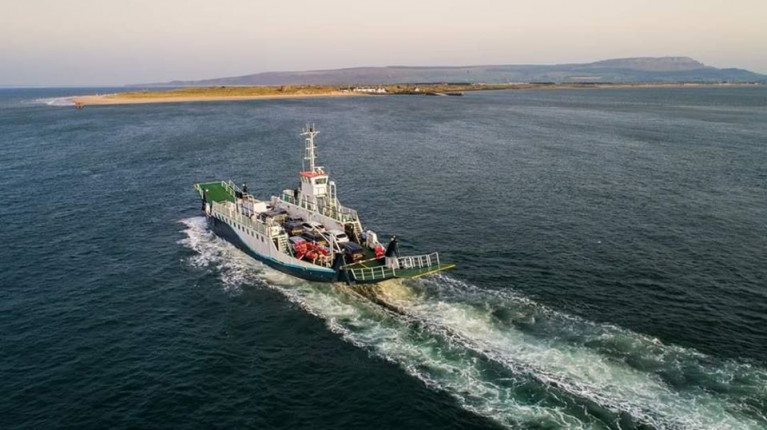
At more than a half century of service, the Cork-built Strangford Ferry, now renamed Frazer Strangford, had called to Wicklow Port overnight prior to making a repositioning voyage from New Ross to Greencastle, Donegal on Lough Foyle. The 53 year old veteran with three vehicle lanes is a 'reserve' ferry on the seasonal Foyle service linking to Magilligan Point as above. At more than a half century of service, the Cork-built Strangford Ferry, now renamed Frazer Strangford, had called to Wicklow Port overnight prior to making a repositioning voyage from New Ross to Greencastle, Donegal on Lough Foyle. The 53 year old veteran with three vehicle lanes is a 'reserve' ferry on the seasonal Foyle service linking to Magilligan Point as above. Credit: Scenic Lough Foyle Ferry-facebook

The oldest car ferry built in Ireland, Frazer Strangford, Afloat tracked to Wicklow Port to take on bunkers it is understood, before continuing a coastal passage to Lough Foyle that departed two hours before dawn today, writes Jehan Ashmore.

The 1969 built Frazer Strangford had yesterday evening berthed at Wicklow port's Packet Quay following a routine dry-docking at New Ross Boatyard in readiness of the Lough Foyle seasonal ferry service. Albeit, the 32.9m vessel is a reserve ferry on the 15 minute trip between Greencastle in Donegal and Magilligan Point, Derry.   

Limerick based ferry group, Frazer Ferries which runs the Lough Foyle Ferry, uses the Frazer Mariner as the lough's main ferry. Commenting to Afloat, Frazer Ferries said the ferry service is scheduled to resume operating in April and continue up to September.

As of this afternoon the 20 car/263 passenger Strangford Ferry is offshore of Co. Down coast and is from where the small inshore ferry had operated for decades on Strangford Lough for the Road Services Department of Down County Council. An order for the newbuild was placed with Verolme Dockyard, Cork with the new coastal ferry launched onto the 10 minute link between Strangford and Portaferry.

The ferry service across Strangford Lough was subsequently transferred to other Northern Ireland agencies. Currently, the link is run by Strangford Lough Ferry Service as part of the Department for Infrastructure (DfI)'s Roads Southern Division.

Strangford Ferry of 186 tons was directly replaced by a much larger newbuild, Strangford II of 405 tons which Afloat reported in 2016. The 64m ferry was completed on the other side of the Irish Sea at Cammell Laird shipbuilders on Merseyside.

The Birkenhead based shipyard delivered Strangford II to run in tandem with the Portaferry II dating to 2001. This ferry was also built on the Wirral Peninsula but by McTay Marine of Bromborough. Each of the ferries can transport 28 cars and 260 passengers.

With the Strangford Ferry II in service, the predecessor was withdrawn in 2017 and sold to Aranmore Island Ferry Services as their renamed Strangford I, however the next year the ferry was resold to Frazer Ferries.   

Howley's Quay is where Frazer Ferries head office in Limerick has further operations involving two more ferry divisions. Firstly, the Carlingford Lough Ferry, the newest coastal car ferry service on this island having opened in 2017. In addition, the Passage East Ferry service in Waterford Estuary sees Frazer Tintern carry out a mere seven-minute service to Ballyhack on the Wexford coast.

Both the Carlingford and Passage East operations were taken over by Frazer Ferries during 2016.

The fourth and largest vessel of the mid-west based ferry group, Frazer Aisling Gabrielle (formerly, Shannon Willow) operates across Carlingford Lough. This is the longest of the three routes that involves a 20 minute crossing time to connect the counties of Louth and Down. The new service created flexilble transport options for the first time and a boost in tourism to the region. 

As Afloat reported in 2017, the Frazer Aisling Gabrielle had also called to Wicklow Port. This stopover was to enable bunkering, following the ferry under new management, made an inaugural dry-docking at New Ross Boatyard.

The ferry having called to the east coast port, continued the second leg of its coastal delivery up the Irish Sea to Carlingford Lough.


Published in Ferry
Jehan Ashmore

About The Author

Jehan Ashmore

Email The Author

Jehan Ashmore is a marine correspondent, researcher and photographer, specialising in Irish ports, shipping and the ferry sector serving the UK and directly to mainland Europe. Jehan also occasionally writes a column, 'Maritime' Dalkey for the (Dalkey Community Council Newsletter) in addition to contributing to UK marine periodicals. 

We've got a favour to ask

More people are reading Afloat.ie than ever thanks to the power of the internet but we're in stormy seas because advertising revenues across the media are falling fast. Unlike many news sites, we haven't put up a paywall because we want to keep our marine journalism open.

Afloat.ie is Ireland's only full-time marine journalism team and it takes time, money and hard work to produce our content.

So you can see why we need to ask for your help.

If everyone chipped in, we can enhance our coverage and our future would be more secure. You can help us through a small donation. Thank you.

Direct Donation to Afloat button

Ferry & Car Ferry News The ferry industry on the Irish Sea, is just like any other sector of the shipping industry, in that it is made up of a myriad of ship operators, owners, managers, charterers all contributing to providing a network of routes carried out by a variety of ships designed for different albeit similar purposes.

All this ferry activity involves conventional ferry tonnage, 'ro-pax', where the vessel's primary design is to carry more freight capacity rather than passengers. This is in some cases though, is in complete variance to the fast ferry craft where they carry many more passengers and charging a premium.

In reporting the ferry scene, we examine the constantly changing trends of this sector, as rival ferry operators are competing in an intensive environment, battling out for market share following the fallout of the economic crisis. All this has consequences some immediately felt, while at times, the effects can be drawn out over time, leading to the expense of others, through reduced competition or takeover or even face complete removal from the marketplace, as witnessed in recent years.

Arising from these challenging times, there are of course winners and losers, as exemplified in the trend to run high-speed ferry craft only during the peak-season summer months and on shorter distance routes. In addition, where fastcraft had once dominated the ferry scene, during the heady days from the mid-90's onwards, they have been replaced by recent newcomers in the form of the 'fast ferry' and with increased levels of luxury, yet seeming to form as a cost-effective alternative.

Irish Sea Ferry Routes

Irrespective of the type of vessel deployed on Irish Sea routes (between 2-9 hours), it is the ferry companies that keep the wheels of industry moving as freight vehicles literally (roll-on and roll-off) ships coupled with motoring tourists and the humble 'foot' passenger transported 363 days a year.

As such the exclusive freight-only operators provide important trading routes between Ireland and the UK, where the freight haulage customer is 'king' to generating year-round revenue to the ferry operator. However, custom built tonnage entering service in recent years has exceeded the level of capacity of the Irish Sea in certain quarters of the freight market.

A prime example of the necessity for trade in which we consumers often expect daily, though arguably question how it reached our shores, is the delivery of just in time perishable products to fill our supermarket shelves.

A visual manifestation of this is the arrival every morning and evening into our main ports, where a combination of ferries, ro-pax vessels and fast-craft all descend at the same time. In essence this a marine version to our road-based rush hour traffic going in and out along the commuter belts.

Across the Celtic Sea, the ferry scene coverage is also about those overnight direct ferry routes from Ireland connecting the north-western French ports in Brittany and Normandy.

Due to the seasonality of these routes to Europe, the ferry scene may be in the majority running between February to November, however by no means does this lessen operator competition.

Noting there have been plans over the years to run a direct Irish –Iberian ferry service, which would open up existing and develop new freight markets. Should a direct service open, it would bring new opportunities also for holidaymakers, where Spain is the most visited country in the EU visited by Irish holidaymakers ... heading for the sun!




















