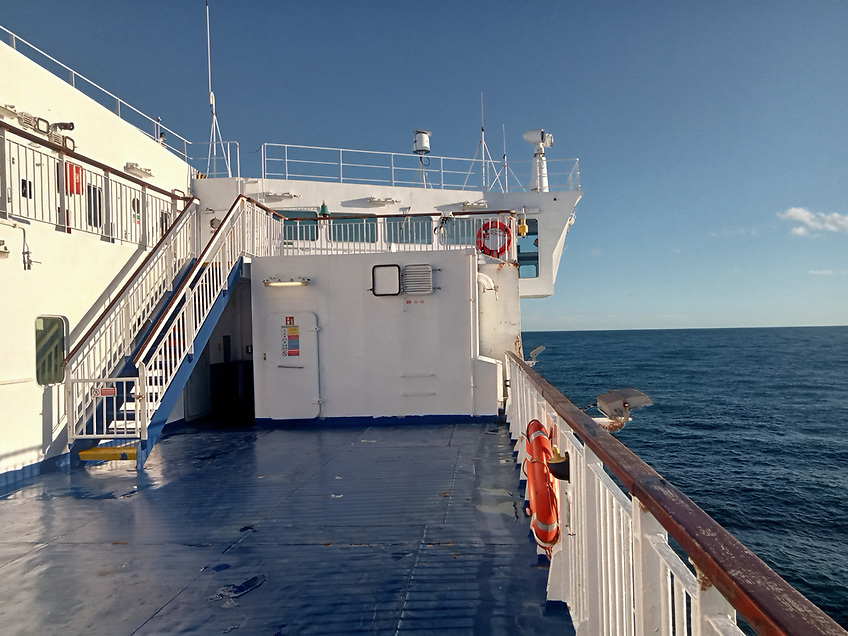
Stena Vision, which a week ago ended the Rosslare-Cherbourg route, arrived at the North African port of Tanger Med, Morocco, yesterday, followed by a passage across the Strait of Gibraltar to Algeciras, Spain, writes Jehan Ashmore.
Since Stena Line withdrew the cruise ferry after sailing on the last day of September on the Ireland-France route, their only link between the Republic and mainland Europe, the cruise ferry initially went to anchor off the Wexford ferryport.
On the following day, 1st October, Brittany Ferries increased capacity and became the route's new sole operator, while the Stena Vision departed on a much longer voyage, involving the Bay of Biscay and offshore of the Iberian Peninsula states of Portugal and Spain.
It is no surprise that the fuel-thirsty, 38-year-old and expensive-to-run veteran vessel has left Stena’s northern European fleet with its increased modern E-Flexer fleet of recent years. Its extensive and more luxurious passenger facilities were favourable, but notably less demanded in the winter on the longer continental route, and along with reduced freight capacity, earning capability was a factor. In addition, it was replaced earlier this year by the more suitable but basic freight ‘ropax’ predecessor Stena Horizon, which headed to the Baltic Sea, as another Stena ropax was sold overseas for New Zealand’s inter-islander service.
As for Stena Vision's calls to both Europe and African ports for berthing trials, could the ship be joining the fleet of African Morocco Link (AML) given their aging Morocco Sun was also withdrawn from charter service with Spain? The former North Channel ferry, Galloway Princess, purpose-built by Harland & Wolff, Belfast, in 1979 for Sealink/British Rail’s Larne-Stranraer route, is either to be sold or to be scrapped?
After its Sealink career, the twin-funnelled ferry, under Stena ownership as the renamed Stena Galloway, continued to serve the North Channel and a relief role on the (former) Dun Laoghaire-Holyhead route, having taken a sailing, until the ferry was sold in 2002. Less than a decade later, the Swedish firm radically changed operations as both North Channel ports were relocated, to form a new route, Belfast-Cairnryan, which enabled the introduction of the High-Speed Service (HSS) catamaran craft, Stena Voyager, joining older conventional tonnage transferred from the well-established route. Currently, the short-sea route is served by twin ‘Superfast’ ferries, which previously ran in the Baltic for different owners.
The 1001-passenger capacity Morocco Sun has been berthed at Tangier Ville since 12 September, and its last port of call was Tangier Med, where AML also operates to Algeciras, Spain, and Tangier-Tarifa, further to the west along southern Spain, using a fleet of two ferries as further outlined. As Afloat speculated in 2024, a former Rosslare-Fishguard ferry, Stena Europe, would return to AML (which Stena acquired a 49% stake in also last year), and the Morocco Star (ex. Danish train ferry) with just 935 passengers and two fast ferries also running on the strait. The ‘Europe’ has a capacity of over 1,300 passengers and is similar to the ‘Vision,’, which would boost capacity considerably on the short-sea service with increased daily frequency.
A twin of the 1987-built Stena Vision, albeit a year younger, the Stena Spirit continues on the Sweden-Poland route of Karlskrona-Gdynia, where the ‘Vision’ had also served, though newer E-Flexers have been introduced in recent years, bringing economical efficiencies and greener credentials. So the question is posed as to what will happen to the ‘Spirit’ if it is also Med-bound, and this too remains open to speculation.
In the meantime, Stena Vision last night headed further into the Mediterranean in an easterly direction and into a shipping lane. However, according to AIS, the ship is bound in the opposite direction for Gibraltar today. Will it remain there before taking up AML service, or will it provide a brief crew break and bunkers for the next port of call?