
























Menu

Ireland's sailing, boating & maritime magazine

RBC Brewin Dolphin proudly supporting Afloat and Irish Boating

Irish Ports See Divergence in Unitised Traffic Q1-Q2 2025 - IMDO

21st October 2025
In the first half of 2025, unitised traffic—Roll-on/Roll-off (RoRo) volumes in the Republic of Ireland declined modestly, falling by 2% to 573,038 units. For figures relating to Lift-on/Lift-off (LoLo) and more, see the IMDO report below.
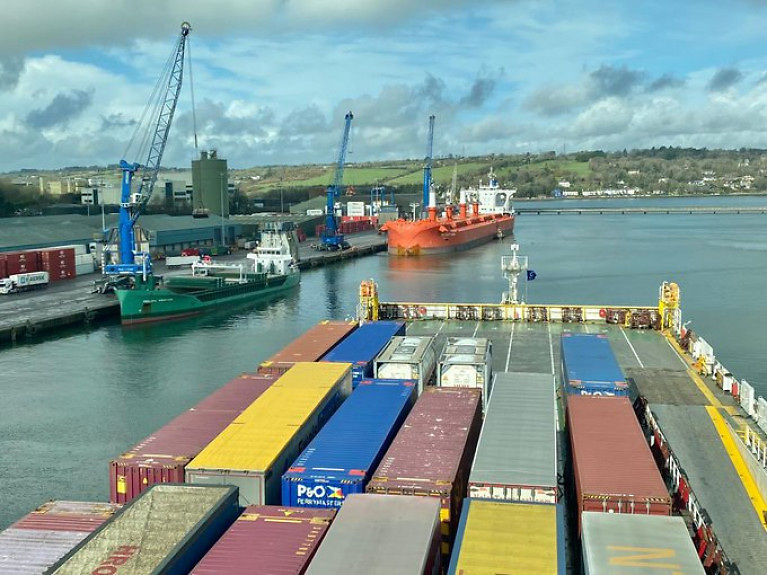
In the first half of 2025, unitised traffic—Roll-on/Roll-off (RoRo) volumes in the Republic of Ireland declined modestly, falling by 2% to 573,038 units. For figures relating to Lift-on/Lift-off (LoLo) and more, see the IMDO report below. Credit: Port of Cork

The Irish Maritime Development Office (IMDO) has released an Executive Summary for the Unitised Traffic Report for Q1 and Q2, 2025.

In the first half of 2025, unitised traffic through ports on the island of Ireland exhibited diverging patterns across the two principal cargo modes. Roll-on/Roll-off (RoRo) volumes in the Republic of Ireland declined modestly, falling by 2% to 573,038 units, while Northern Ireland recorded a 2% increase to 460,730 units.

By contrast, Lift-on/Lift-off (LoLo) throughput grew strongly in the Republic of Ireland, increasing by 11% to 643,631 TEUs, while remaining broadly stable in Northern Ireland at 109,412 TEUs. The combined effect is that all-island RoRo traffic was largely unchanged from 2024 levels, while all-island LoLo volumes rose by 9%.

These traffic outcomes took place against a backdrop of favourable macroeconomic conditions. According to the Central Statistics Office, inflation in Ireland averaged 1.6% in the first half of 2025, below the Eurozone average of 2%. Unemployment stood at 4.7%, compared with 5.9% in the EU, while employment levels remain historically high, with half a million additional jobs created since 2019. 1 Fiscal policy has also remained expansionary, supported by elevated corporation tax receipts. The Government’s Summer Economic Statement 2022 announced €34 billion in additional capital investment over the next decade, including electrical grid, water, housing, and transport infrastructure. These indicators point to continued strength in the domestic economy and provide a supportive environment for trade flows through Irish ports.

Within this context, the most notable development in recent quarters has been the divergence in trends between the RoRo and LoLo markets. The IMDO’s analysis using a Hodrick–Prescott (HP) filter of quarterly time series data highlights this divergence clearly. The HP filter is a standard statistical tool used in economics to separate long-term trends from short-term fluctuations. When applied to RoRo and LoLo volumes, it shows that RoRo traffic has plateaued and is gradually declining, while LoLo traffic is on a pronounced upward trajectory. The chart below illustrates these opposing movements, with LoLo throughput reaching new highs while RoRo stabilises.

This juxtaposition is significant for policymakers and industry stakeholders, as RoRo and LoLo represent approximately half of all freight transport through Irish ports. Their diverging paths have implications for infrastructure planning and future capacity requirements. The relationship between the two modes is complex, with substitutability varying across markets, routes, and product groups. The IMDO continues to analyse these dynamics and engage with shipping operators, port companies, and trade stakeholders to better understand the drivers.

The evidence to date confirms that the unitised freight market remains resilient, with LoLo recording record throughput in the Republic of Ireland and RoRo volumes holding steady. The differing trajectories underline the importance of continuous monitoring, rigorous analysis, and open dialogue with industry.

The IMDO will continue to report quarterly on these developments, providing government and stakeholders with objective and timely information to inform policy and investment decisions.


Published in Irish Ports
Jehan Ashmore

About The Author

Jehan Ashmore

Email The Author

Jehan Ashmore is a marine correspondent, researcher and photographer, specialising in Irish ports, shipping and the ferry sector serving the UK and directly to mainland Europe. Jehan also occasionally writes a column, 'Maritime' Dalkey for the (Dalkey Community Council Newsletter) in addition to contributing to UK marine periodicals. 

We've got a favour to ask

More people are reading Afloat.ie than ever thanks to the power of the internet but we're in stormy seas because advertising revenues across the media are falling fast. Unlike many news sites, we haven't put up a paywall because we want to keep our marine journalism open.

Afloat.ie is Ireland's only full-time marine journalism team and it takes time, money and hard work to produce our content.

So you can see why we need to ask for your help.

If everyone chipped in, we can enhance our coverage and our future would be more secure. You can help us through a small donation. Thank you.

Direct Donation to Afloat button

As an island economy, a healthy maritime sector is key to our national competitiveness. Virtually all our imports and exports pass through Irish ports.

Ireland is dependent on ports and shipping services to transport goods and 90% of our trade is moved though Irish ports. Shipping and maritime transport services make a significant contribution to Ireland’s ocean economy, with the sector generating €2.3 billion in turnover and employing over 5,000 people in 2018.

Ireland’s maritime industry continues to grow and progress each year with Irish ports and shipping companies making significant investments. The ports sector in Ireland is currently undergoing a number of expansions and developments with Dublin Port’s Alexandra Basin development, the development of Ringaskiddy in Cork by Port of Cork and the development of Shannon Foynes Port. Along with these major investments, shipping companies are also investing heavily in new tonnage, with Irish Ferries, CLdN and Stena leading new build programmes.

These pages cover the following sectoral areas: shipowners, harbour authorities, shipbrokers, freight forwarders and contractors, cruise liner operators, port users, seamen, merchants, academic institutions, shipyards and repair facilities, naval architects, navy and defence personnel.

Our pages are covering some of the most notable arrivals around our coast and reporting too on port development and shipping news.

This section of the site deals with Port and Shipping News on our largest ports Dublin Port, Port of Cork, the Shannon Estuary, Galway Harbour and Belfast Lough.

A recent study carried out for the Irish Ports Association (IPA) totalled 75.7 billion during 2004 and their net economic impact was some 5.5 billion supporting around 57, 500 full time employees.

Liam Lacey, Director of the Marine Institute’s Irish Maritime Development Office (IMDO) said, “The Irish maritime industry can look to the future with confidence. It has shown itself to be resilient and agile in responding to challenges. Over the past decade, it has had to respond to the challenges of the financial crisis of 2008, the uncertainty surrounding Brexit and recent challenges. Ireland’s maritime sector has continued to underpin our economy by maintaining vital shipping links for both trade and tourism.”




















