
























Menu

Ireland's sailing, boating & maritime magazine

RBC Brewin Dolphin proudly supporting Afloat and Irish Boating

Merseyside Shipyard's Keel-Laying Ceremony for First of Two Scottish Ferries

28th November 2025
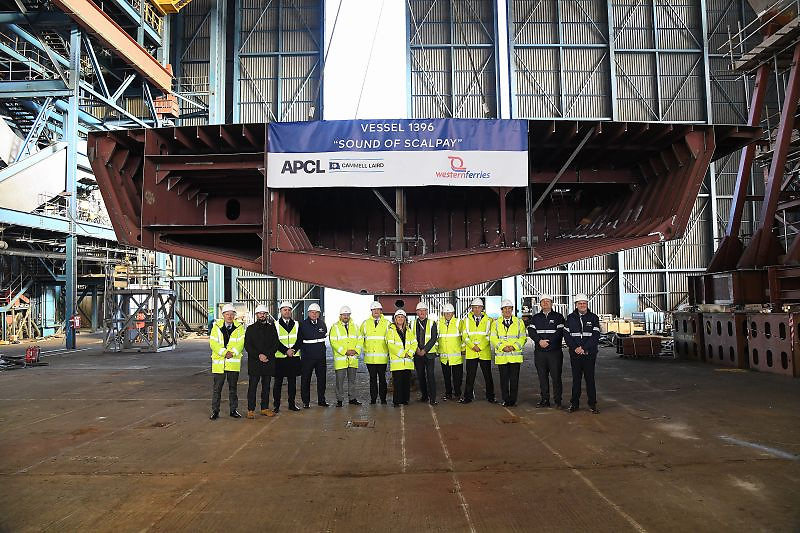
The keel-laying ceremony of the newbuild ferry for Scottish operator Western Ferries took place at the Merseyside shipyard, Cammell Laird. The ferry is named the Sound of Scalpay.
The keel-laying ceremony of the newbuild ferry for Scottish operator Western Ferries took place at the Merseyside shipyard, Cammell Laird. The ferry is named the Sound of Scalpay. Credit: Cammell Laird-LinkedIn

On Merseyside, at the shipbuilder in Cammell Laird, Birkenhead, the keel-laying ceremony for the first of two new Western Ferries newbuilds took place for the Scottish operator.

The car and passenger ferry on Tuesday has also been named the MV Sound of Scalpay.

The multimillion-pound contract for the pair was awarded to Cammell Laird (part of the APCL group) to build the vessels for Western Ferries in May 2025. The second ferry will be named the MV Sound of Sleat.

This latest contact is a repeat order of the Western Ferries and Cammell Laird design, which produced the MV Sound of Seil and MV Sound of Soay, both of which in 2013 were constructed at Birkenhead. Since their delivery, both ferries have been stalwarts of Western Ferries’ four-vessel fleet, contributing to the delivery of around 32,000 annual sailings.

At 50m, the double-ended ferry is designed to carry 220 passengers and 40 cars and will operate on Western Ferries’ Gourock to Dunoon route.

The 2013 design has been further optimised to minimise fuel consumption and increase the efficiency of operation. Fuel efficiency savings have been achieved principally by the efficient matching of the hull design to the propulsion package, the reduction of permanent ballast installed, and the selection of low energy consumption machinery, providing both environmental and through-life benefits.

The shipbuilders' design team has also enhanced the original design of the superstructure to improve the aesthetics, with upgrades being made to the heating and ventilation system to improve the passenger and crew experience.


Published in Shipyards
Jehan Ashmore

About The Author

Jehan Ashmore

Email The Author

Jehan Ashmore is a marine correspondent, researcher and photographer, specialising in Irish ports, shipping and the ferry sector serving the UK and directly to mainland Europe. Jehan also occasionally writes a column, 'Maritime' Dalkey for the (Dalkey Community Council Newsletter) in addition to contributing to UK marine periodicals. 

We've got a favour to ask

More people are reading Afloat.ie than ever thanks to the power of the internet but we're in stormy seas because advertising revenues across the media are falling fast. Unlike many news sites, we haven't put up a paywall because we want to keep our marine journalism open.

Afloat.ie is Ireland's only full-time marine journalism team and it takes time, money and hard work to produce our content.

So you can see why we need to ask for your help.

If everyone chipped in, we can enhance our coverage and our future would be more secure. You can help us through a small donation. Thank you.

Direct Donation to Afloat button

Shipyards

Afloat will be focusing on news and developments of shipyards with newbuilds taking shape on either slipways and building halls.

The common practice of shipbuilding using modular construction, requires several yards make specific block sections that are towed to a single designated yard and joined together to complete the ship before been launched or floated out.

In addition, outfitting quays is where internal work on electrical and passenger facilities is installed (or upgraded if the ship is already in service). This work may involve newbuilds towed to another specialist yard, before the newbuild is completed as a new ship or of the same class, designed from the shipyard 'in-house' or from a naval architect consultancy. Shipyards also carry out repair and maintenance, overhaul, refit, survey, and conversion, for example, the addition or removal of cabins within a superstructure. All this requires ships to enter graving /dry-docks or floating drydocks, to enable access to the entire vessel out of the water.

Asides from shipbuilding, marine engineering projects such as offshore installations take place and others have diversified in the construction of offshore renewable projects, from wind-turbines and related tower structures. When ships are decommissioned and need to be disposed of, some yards have recycling facilities to segregate materials, though other vessels are run ashore, i.e. 'beached' and broken up there on site. The scrapped metal can be sold and made into other items.