
























Menu

Ireland's sailing, boating & maritime magazine

RBC Brewin Dolphin proudly supporting Afloat and Irish Boating

‘Mistral’ Class French Helicopter Carrier Visits Cork Harbour ahead of Major Atlantic Exercise

28th May 2025
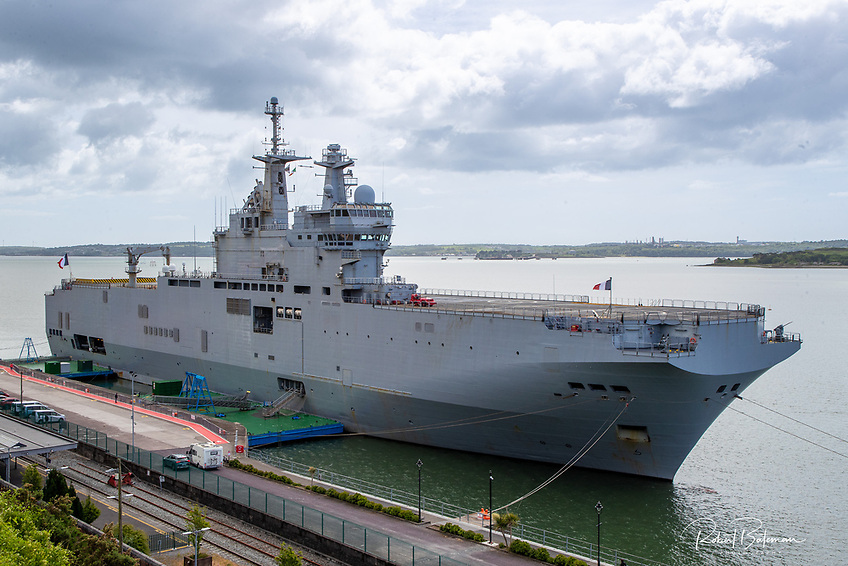
The French Navy’s Tonnerre (L914) is visiting Cork Harbour prior to taking part in a major amphibious assault exercise off the west coast of France. The 21,300 displacement ton (full load) multi-role visiting (MRV) berthed at Cobh’s Deepwater ‘cruise-ship’ quay. The ‘Mistral’ class vessel was built in two parts, Afloat highlights, with the aft section at Arsenal de Brest in Brest, Brittany, and the bow by Chantiers de Saint-Nazaire in Saint-Nazaire (builders of the cruise liner Queen Mary 2 or ‘QM2’). The carrier’s launch was in 2005, and it entered service in late 2006, with it based out of the Mediterranean port of Toulon.
The French Navy’s Tonnerre (L914) is visiting Cork Harbour prior to taking part in a major amphibious assault exercise off the west coast of France. The 21,300 displacement ton (full load) multi-role visiting (MRV) berthed at Cobh’s Deepwater ‘cruise-ship’ quay. The ‘Mistral’ class vessel was built in two parts, Afloat highlights, with the aft section at Arsenal de Brest in Brest, Brittany, and the bow by Chantiers de Saint-Nazaire in Saint-Nazaire (builders of the cruise liner Queen Mary 2 or ‘QM2’). The carrier’s launch was in 2005, and it entered service in late 2006, with it based out of the Mediterranean port of Toulon. Credit: Bob Bateman

A large French Navy helicopter and amphibious assault vessel visiting Cobh, Cork Harbour, is from where its captain has spoken about his ship’s warfighting but also humanitarian mission.

The second of the ‘Mistral’ class, Tonnerre (L914), which arrived on Sunday, is on a five-day visit to Cobh this week, berthing at the town’s cruise berth. This is to enable a rest-up period for the crew before the 199m naval vessel takes part in a major amphibious assault exercise on the west coast of France.

Tonnere means thunder in French, and it is a specialist multi-role vessel (MRV) that is designed to carry helicopters, military vehicles, and landing craft, as well as a battalion of marines. In addition to featuring an on-board hospital.

On Monday evening, an event held also on board is where Capitaine de Vaisseau (or, in English, Sea Captain) Adrien Schaar and other officers had lengthy discussions with the head of the Naval Service, Commodore Michael Malone.

Also in attendance were the French ambassador, Céline Place, and several Irish and French business leaders, county councillors, and serving and former TDs.

More reports The Journal which mentioned topics, among them the purchasing of sonar equipment for the Naval Service, in which French officials said they were not aware of progress to acquire from a French arms company. 

The vessel with its 6m draft is to depart the deepwater berth tomorrow evening. 

Published in Naval Visits
Jehan Ashmore

About The Author

Jehan Ashmore

Email The Author

Jehan Ashmore is a marine correspondent, researcher and photographer, specialising in Irish ports, shipping and the ferry sector serving the UK and directly to mainland Europe. Jehan also occasionally writes a column, 'Maritime' Dalkey for the (Dalkey Community Council Newsletter) in addition to contributing to UK marine periodicals. 

We've got a favour to ask

More people are reading Afloat.ie than ever thanks to the power of the internet but we're in stormy seas because advertising revenues across the media are falling fast. Unlike many news sites, we haven't put up a paywall because we want to keep our marine journalism open.

Afloat.ie is Ireland's only full-time marine journalism team and it takes time, money and hard work to produce our content.

So you can see why we need to ask for your help.

If everyone chipped in, we can enhance our coverage and our future would be more secure. You can help us through a small donation. Thank you.

Direct Donation to Afloat button

Naval Visits focuses on forthcoming courtesy visits by foreign navies from our nearest neighbours, to navies from European Union and perhaps even those navies from far-flung distant shores.

In covering these Naval Visits, the range of nationality arising from these vessels can also be broad in terms of the variety of ships docking in our ports.

The list of naval ship types is long and they perform many tasks. These naval ships can include coastal patrol vessels, mine-sweepers, mine-hunters, frigates, destroyers, amphibious dock-landing vessels, helicopter-carriers, submarine support ships and the rarer sighting of submarines.

When Naval Visits are made, it is those that are open to the public to come on board, provide an excellent opportunity to demonstrate up close and personal, what these look like and what they can do and a chance to discuss with the crew.

It can make even more interesting for visitors when a flotilla arrives, particularly comprising an international fleet, adding to the sense of curiosity and adding a greater mix to the type of vessels boarded.

All of this makes Naval Visits a fascinating and intriguing insight into the role of navies from abroad, as they spend time in our ports, mostly for a weekend-long call, having completed exercises at sea.

These naval exercises can involve joint co-operation between other naval fleets off Ireland, in the approaches of the Atlantic, and way offshore of the coasts of western European countries.

In certain circumstances, Naval Visits involve vessels which are making repositioning voyages over long distances between continents, having completed a tour of duty in zones of conflict.

Joint naval fleet exercises bring an increased integration of navies within Europe and beyond. These exercises improve greater co-operation at EU level but also internationally, not just on a political front, but these exercises enable shared training skills in carrying out naval skills and also knowledge.

Naval Visits are also reciprocal, in that the Irish Naval Service, has over the decades, visited major gatherings overseas, while also carrying out specific operations on many fronts.

Ireland can, therefore, be represented through these ships that also act as floating ambassadorial platforms, supporting our national interests.

These interests are not exclusively political in terms of foreign policy, through humanitarian commitments, but are also to assist existing trade and tourism links and also develop further.

Equally important is our relationship with the Irish diaspora, and to share this sense of identity with the rest of the World.





















