Singer Neil Young's superyacht may have sailed away, but Dun Laoghaire is about to rock again this Thursday as European champions are among 100-plus cruiser racers competing for IRC honours as part of Ireland's biggest sailing event, Volvo Dun Laoghaire Regatta, now boasting over 330 entries.
 Crews attend the Volvo Dun Laoghaire Regatta pre-race briefing at the Royal Irisih Yacht Club Photo: Michael Chester
Sunshine and sea breeze have arrived on Dublin Bay, so thermal winds will be the hot property for the regatta's four days from Thursday (July 10) to Sunday (July 13).
 International Race Officer Con Murphy delivers the 2025 Volvo Dun Laoghaire Regatta pre-race briefing Photo: Michael Chester
The south-easterly sea breeze materialises in the early afternoon, meaning any morning races could be sailed in a light air gradient of sub-ten mph, and afternoon races could be sailed in the full strength of an afternoon sea breeze at 15 mph, typically from a direction of 145 degrees. Provided, that is, that the high-pressure system hasn't squatted down on the bay so heavily as to suffocate normal wind patterns.
 The Volvo Dun Laoghaire Race track - Dublin Bay is approximately 70 sq kilometres or 7,000 hectares. The Bay is about 10 kilometres wide along its north-south base, and seven km in length east-west to its peak at the centre of the city of Dublin; stretching from Howth Head in the north to Dalkey Point in the south.
Sea breeze conditions also present the prospect of smaller boats being able to finish races in stronger breezes, depending on when races start.
Knowing the likely conditions provides a hint of who the favourites might be in a potent fleet that has gathered to decide Volvo Dun Laoghaire titles in six classes (under IRC and ECHO handicaps), so Afloat sticks its neck out (below) with some predictions, class by class.
The four-day week starts with a First Gun on Thursday at 2 pm and the new Bay Race with a south-easterly wind forecast at 10 mph.
These sea breeze conditions appear likely to persist right through to Sunday's conclusion, so overall, it's a scenario that offers sailing throughout the light to medium wind range.
While there have been some Volvo Dun Laoghaire organisational adjustments to original plans since Afloat's last regatta sneak peek, the 'VDLR 2025' is on course to deliver, with entries now recorded at 332 boats across IRC and one design fleets. The action will take place across six different race courses offering coastal, windward-leeward and fixed mark courses.
 The VDLR 2025 racing action will take place across six different race courses offering coastal, windward-leeward and fixed mark courses
If Windward-leeward courses are a dominant feature of the regatta, asymmetric kites may produce a light-air advantage, while symmetric spinnaker boats may produce an edge in stronger breezes as they carry kites deeper downwind.
Checkmate XX to Defend Coastal and Overall VDLR Crown
 Howth's First 50, Checkmate XX Photo: Afloat
Coastal A (14 starters) The clear favourite in the regatta's second biggest class, with the mix of conditions expected, must be last month's Sovereign's Cup winner (with four straight wins), the First 50, Checkmate XX of Nigel Biggs and Dave Cullen. As regular Afloat readers will know, the Howth yacht is also VDLR's defending overall champion after her 2023 performance in the offshore class.
 Chris Power Smith's J122 Aurelia of the RStGYC Photo: Afloat
This class comprises battle-hardened ISORA campaigners who are well accustomed to navigating the Dublin and Wicklow coastlines, so there's always the chance of a slip-up.
 Paul O'Higgins' JPK 10.80 Rockabill VI of the Royal Irish Photo: Afloat
Enter former ISORA champion, the JPK 10.80 Rockabill VI (Paul O'Higgins of the Royal Irish) and the J122 sisterships, Mojito (Victoria Cox and Peter Dunlop from North Wales) and the current ISORA series leader, Chris Power Smith's Aurelia from the Royal St. George Yacht Club.
 The J122 Mojito of Victoria Cox and Peter Dunlop from North Wales Photo: Afloat
Added to this top group is Johnny Treanor's National Yacht Club J112e, Valentia, which was last year's Cork Week Boat of the Week.
 Johnny Treanor's National Yacht Club J112e, Valentia Photo: Afloat
Although some pundits say light winds may not suit Rockabill VI, depending on what wind strength arrives on the coastal courses, expect two of these four boats to fill the rest of the Coastal A podium.
Ruth Looks Strong in Coastal B Division
 ISORA Champion Tom Shanahan in the J109 Ruth Photo: Afloat
Coastal B (9 starters) Four J109s that are typically to be found at the top end of the IRC One division have opted for coastal racing this week, which means reigning ISORA Champion Tom Shanahan in the J109 Ruth from the National Yacht Club must be the one to watch. Across the Channel from Pwllheli comes William Partington's Archambault A35 Andromeda, with the only other contender from outside the bay being Steve Hayes's First 34.7 Magic Touch from neighbouring Greystones Harbour in County Wicklow.
The coastal classes will sail the Bay race on Thursday and three daily coastal races from the Outer Bay Race Area, near Omega mark, under Race Officer Michael Tyrrell.
Impetuous v Big Picture: IRC Zero Competition Heats Up
 IRC Welsh National Champions Impetuous (Crompton/Miller/Hodges) Photo: Bob Bateman
Cruiser Zero (8 starters) - Welsh windward-leeward specialist Impetuous (Crompton/Miller/Hodges) has already chalked up a Class One win in the IRC Welsh National Championship in May, but this Pwllheli crew was unable to match the pace of the Evans brothers' well-practised J112e Big Picture from Howth last month at the Sovereign's Cup.
 The Evans brothers' J112e 'The Big Picture' from Howth Photo: Afloat
The South Caernarfonshire Corby 37 will have to contend again with the Evans brothers, who earned a neat victory at Sovereign's; either of these can take the class title, but keep an eye out too for the breeze queen Final Call II, John Minnis's A35 from Belfast Lough, especially if Dublin Bay's sea breeze pipes up.
Champion Outrajeous Will Have the Edge in IRC One
 Johnny and Suzie Murphy's top-performing Outrajeous of Howth Photo: Afloat
Cruisers One (13 starters) - In a fleet of 13, 11 J109s are set to compete against Johnny and Suzie Murphy's top-performing Outrajeous of Howth. But who has the boat speed to challenge the reigning National, European, Dun Laoghaire- Dingle and Sovereign's Cup Champion?
 The Hall family's J/109, Something Else, shines at the Scottish Series, securing the overall title under Brian Hall's leadership with impressive first-place finishes Photo: Scottish Series
One likely candidate is the winner of last May's Scottish Series, Something Else. The John and Brian Hall J109 from the National Yacht Club is also the current series leader in the local Dublin Bay Sailing Club series, and what's more, they will have four-time Olympian Mark Mansfield on board. Strong competition will also come from Bay experts Tim and Richard Goodbody on White Mischief and Royal Irish clubmates Barry Cunningham's Chimaera, plus five-time national J109 champion, John Maybury in Joker II.
 Tim and Richard Goodbody on White Mischief from the Royal Irish Yacht Club Photo: Afloat
Half Tonner Swuzzlebubble to Lead IRC Two
 Swuzzlebubble sailed by James and Dave Dwyer Photo: Bob Bateman
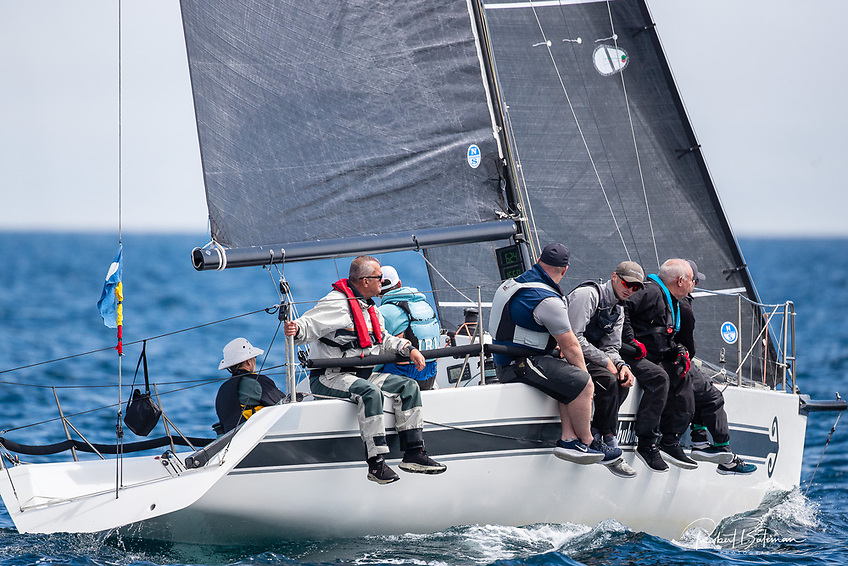
Cruisers Two (12 starters) – In the absence of the Half Tonner 2Farr that took the class win in Sovereign's Cup last month, the Royal Cork's Swuzzlebubble (James Dwyer), as ICRA Boat of the Year, is a clear favourite in this 12-boat class. Competition for one of the few RCYC entries attending VDLR this year will come from DBSC's local Royal St. George fleet, including Lindsay Casey's J97 Windjammer, the current leader of the DBSC summer series, as well as the First 8 Allig8r of Brendan Foley from the Royal St. George YC. From across the Bay, Colin Kavanagh's J97 General Lee will also be fighting for a podium place, as will Frank Whelan's A31 Crazy Diamond from Greystones Harbour.
 Brendan Foley's all black First 8 Allig8rfrom the Royal St. George YC Photo: Afloat
After Thursday's Bay Race, the Cruiser Zero, One and Two Classes will compete in the North Racing Area on fixed marks or windward leeward courses on Friday and Saturday. On Sunday, they conclude racing on the Outer Bay course with the coastal classes.
IRC 3 Has Mix of One Design Keelboats
 Quarter Tonner SKB, raced by Charlie McAllister represents Antrim Boat Club on Lough Neagh at the 2025 VDLR Photo: Afloat
Cruisers Three (17 starters) – With Solings, H-boats, E-Boats, J24s and Quarter Tonners all in the mix in the biggest IRC fleet of the regatta, it proves hard to pick a winner from such a varied bunch, not least because some of these one-designs do not rate well under IRC. It's worth pointing out, however, that a Tralee Bay Soling was the winner of IRC 2 at WIORA in Clew Bay last month, and this week, another County Kerry Soling is racing on Dublin Bay. Overall, though, perhaps the best pick of a potential winner is the news that a sister ship of the recent Quarter ton Cup champion from Cowes last week will be competing. The Antrim Boat Club Quarter Tonner SKB is a Farroux Bullit production-type quarter tonner, which points to some real performance potential for the Charlie McAllister skippered Northern Ireland entry.
After Thursday's Bay Race, the Cruiser Three Class will compete in the North Racing Area on fixed marks on Friday and Saturday. On Sunday, they conclude racing on the Western course in the vicinity of Seapoint with a final windward-leeward race.
See the full entry list here